

workflow integration in ai products refers to the alignment between an ai system and the actual sequence of tasks users perform to achieve an outcome. this includes how inputs are gathered, how outputs are used, how decisions are made, and how results are verified within a real workflow.
ai products frequently fail when they operate as isolated capabilities rather than components of a task system. a model may generate high-quality outputs, but if those outputs require manual transfer, reinterpretation, or repeated validation, the system does not reduce effort at the workflow level. the user absorbs the integration cost instead of the product.
probabilistic behavior introduces additional complexity into workflows. outputs vary across attempts, confidence is implicit rather than explicit, and correctness often requires interpretation. this shifts user effort from execution toward verification and judgment. workflows that previously relied on deterministic steps now require checkpoints, fallbacks, and supervision layers.
for product managers, workflow integration determines whether an ai system creates measurable value. performance improvements at the model level do not translate directly into user impact unless they reduce steps, compress decision cycles, or improve completion rates within the workflow. designing ai products therefore requires understanding how tasks are structured in practice, where uncertainty is introduced, and how users adapt their behavior when interacting with probabilistic systems.
what is workflow integration in ai products
workflow integration in ai products refers to embedding ai capabilities directly into the structure of user tasks, such that the system participates in how work is executed, rather than existing as a separate step.
integration operates at the level of task sequences. a workflow consists of ordered steps, dependencies between those steps, and decision points where users interpret intermediate outputs. ai systems become integrated when they are positioned inside these steps with clear input and output contracts, reducing the need for users to reformat data, switch tools, or reinterpret results.
feature-level ai operates at the interface layer. it exposes capabilities such as text generation, summarization, or classification without aligning to a specific task structure. users must decide when to invoke the feature, how to prepare inputs, and how to use outputs. this introduces variability in usage patterns and shifts coordination effort to the user.
workflow-level ai operates at the task layer. it is invoked automatically or contextually based on the user’s position in a workflow. inputs are derived from existing system state, and outputs are formatted for immediate use in the next step. this reduces decision overhead and standardizes how the ai system contributes to task completion.
in practice, workflow integration requires mapping tasks into discrete stages, identifying where probabilistic outputs can replace or assist deterministic steps, and defining how outputs propagate through the system. this includes handling edge cases such as low-confidence outputs, partial completions, and failure recovery paths.
for example, in a customer support system, a feature-level ai may generate reply drafts in a separate interface. a workflow-integrated ai generates responses within the ticketing system, uses ticket context automatically, suggests actions aligned with support policies, and routes low-confidence cases for human review. the impact comes from how the output participates in the resolution workflow, including how it is generated, validated, and used within the system.
why standalone ai features fail
standalone ai features fail because they introduce additional steps into workflows without removing existing ones.
these systems require users to leave their primary environment, construct prompts, interpret outputs, and manually transfer results back into their workflow. each of these steps adds latency and increases the probability of errors. even when outputs are high quality, the surrounding friction offsets the benefit.
context switching is a primary source of inefficiency. users must shift attention between tools, maintain working memory of the task state, and re-establish context when returning to the original workflow. this increases cognitive load and reduces throughput, especially for tasks that require sustained focus or involve multiple dependencies.
verification overhead increases in standalone systems. outputs are generated without direct access to system state, constraints, or downstream requirements. users must validate correctness, reformat outputs, and ensure compatibility with subsequent steps. this shifts effort from execution to supervision, without reducing total workload.
standalone features also disrupt flow continuity. workflows depend on predictable transitions between steps. when ai outputs are produced outside the workflow, users must decide how and when to integrate them. this introduces variability and reduces consistency across users and sessions.
in collaborative environments, standalone ai creates coordination gaps. outputs generated outside shared systems are harder to track, audit, and reuse. this limits their utility in team workflows where visibility and standardization are required.
over time, users adapt by minimizing reliance on standalone features or using them only for specific sub-tasks. adoption stabilizes at a lower level because the system does not align with how work is actually performed.
where ai fits in a workflow
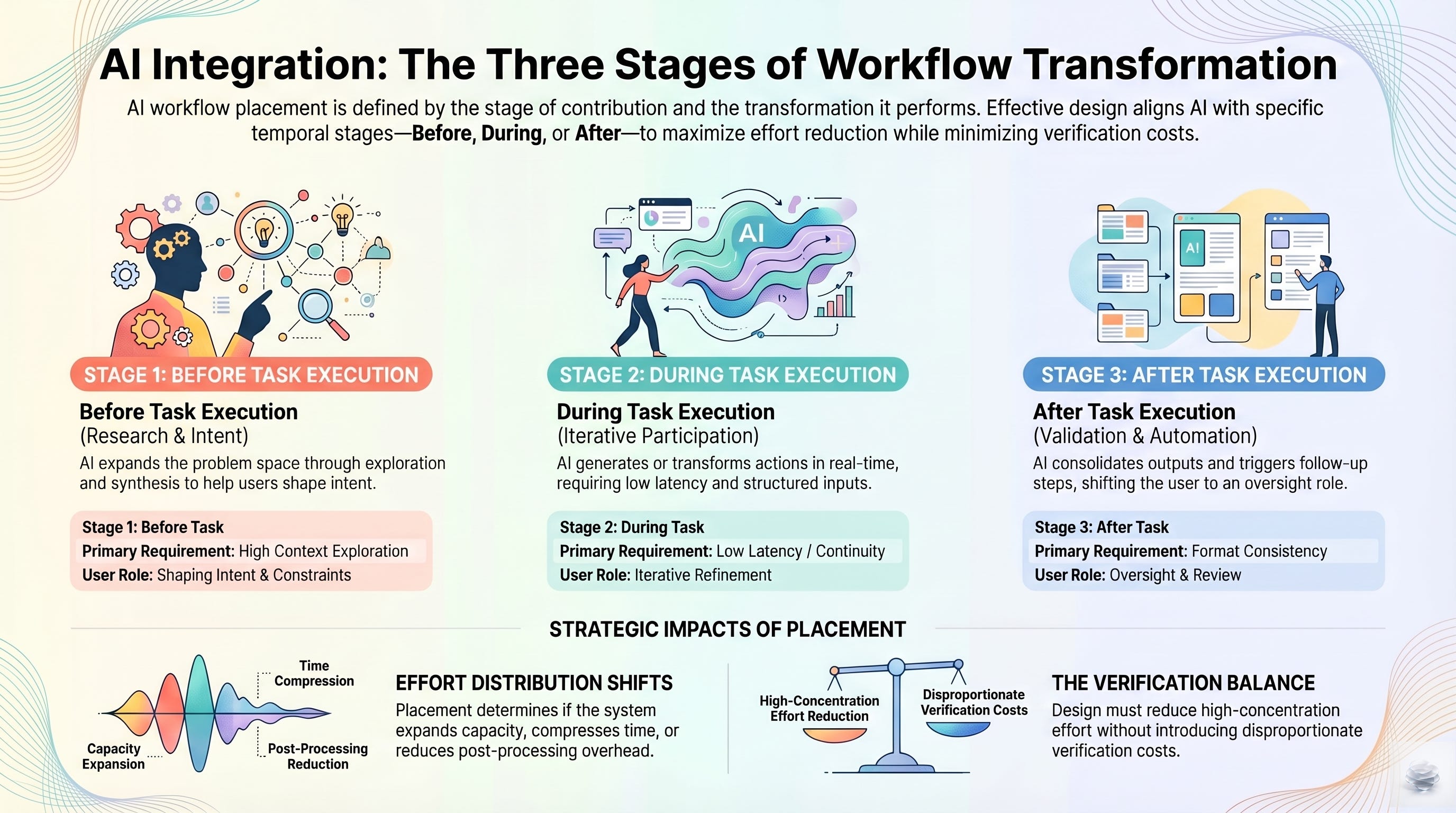
ai placement in a workflow refers to the specific stage at which the system contributes to task execution, along with the type of transformation it performs on inputs and outputs at that stage.
workflows can be decomposed into three broad stages: before task execution, during task execution, and after task execution. each stage imposes different requirements on context, latency, and output reliability.
before task execution involves planning, research, and information gathering. ai systems at this stage operate on incomplete context and are used to expand the user’s understanding of the problem space. outputs are exploratory and often high variance. users rely on these outputs to shape intent, define constraints, and decide next steps. this shifts the early workflow from manual search toward guided synthesis, while increasing the need for source validation and interpretation.
during task execution involves direct participation in the task. ai systems generate, transform, or guide actions in real time. inputs are more structured, and outputs must align with downstream requirements. latency constraints are tighter, and errors have immediate impact on task continuity. users interact with the system iteratively, refining inputs and evaluating outputs in short cycles. this stage introduces a feedback loop between user intent and model behavior, where the system influences how the task itself is performed.
after task execution involves summarization, validation, and automation of follow-up steps. ai systems consolidate outputs, check for inconsistencies, and trigger subsequent actions. outputs at this stage are often consumed by other systems or stakeholders, which increases the importance of format consistency and traceability. users shift from active execution to oversight, reviewing aggregated results and confirming correctness.
the placement of ai within these stages determines how users distribute effort across planning, execution, and verification. early-stage integration expands exploration capacity, mid-stage integration compresses execution time, and late-stage integration reduces post-processing overhead. effective workflow design aligns ai placement with the stage where it can reduce the highest concentration of effort without introducing disproportionate verification cost.
augmentation vs automation
augmentation vs automation describes the degree of control delegated to the ai system within a workflow, defined by how decisions and actions are distributed between the user and the system.
this spectrum can be structured as four modes: assist, suggest, act, and automate. each mode represents a shift in responsibility, interface design, and reliability requirements.
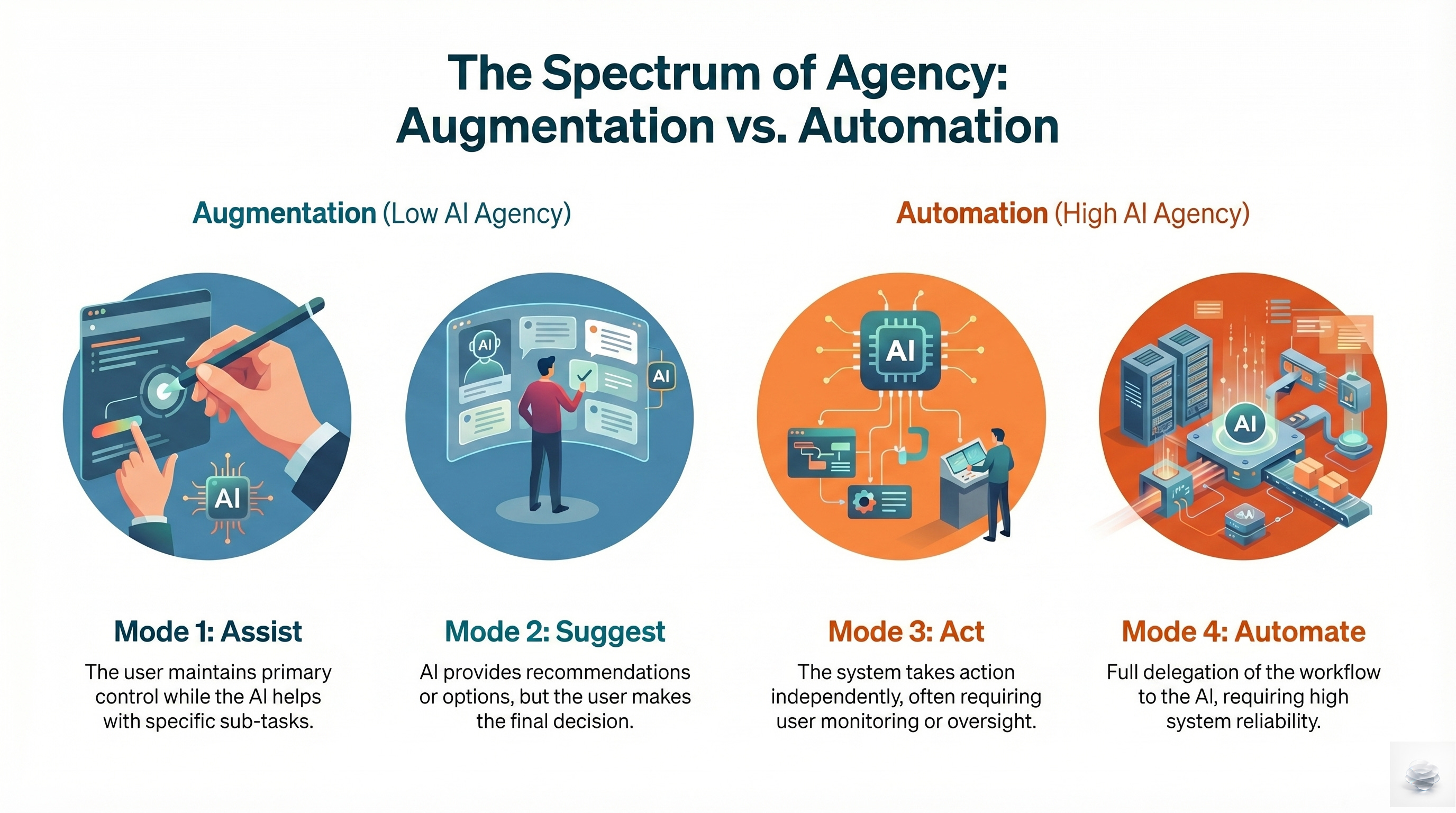
assist refers to ai systems that provide raw outputs without prescribing actions. examples include text generation, summarization, or data extraction presented for user interpretation. the user retains full control over how outputs are used. workflows at this stage include additional verification steps, as outputs are not directly executable.
suggest refers to ai systems that provide context-aware recommendations aligned with the current task. outputs are structured as candidate actions, such as reply drafts, code completions, or decision options. the system begins to incorporate task context and constraints. users evaluate and select from these suggestions, reducing decision effort while maintaining oversight.
act refers to ai systems that execute actions with user confirmation. the system performs operations such as sending messages, updating records, or triggering workflows after explicit approval. this introduces tighter coupling between ai outputs and system state. reliability requirements increase, as errors propagate directly into the workflow upon approval.
automate refers to ai systems that execute actions without explicit user intervention. the system operates continuously or conditionally based on predefined rules and model outputs. workflows are restructured to include monitoring and exception handling rather than step-by-step execution. users shift from operators to supervisors, focusing on edge cases and system performance.
movement across these modes occurs gradually. systems often begin in assist or suggest modes, where risk is contained and user trust can be established. progression toward act and automate requires higher confidence in output correctness, stronger guardrails, and clear rollback mechanisms.
risk boundaries are defined by the cost of incorrect actions. high-impact workflows, such as financial transactions or legal decisions, remain constrained to assist or suggest modes unless strong validation layers are present. lower-impact workflows can tolerate higher levels of automation, provided that monitoring and recovery paths are well-defined.
reliability thresholds increase with each stage. assist systems require output usefulness, suggest systems require contextual relevance, act systems require correctness under approval, and automated systems require sustained accuracy across varying conditions. workflow design must account for these thresholds when determining the appropriate level of automation.
human in the loop workflows
human in the loop workflows refer to task structures where ai systems generate or execute outputs under continuous or conditional human supervision, with defined control points for review, approval, and intervention.
these workflows are designed to manage uncertainty introduced by probabilistic systems. instead of requiring full model correctness, the system distributes responsibility between automated steps and human judgment. this allows the workflow to maintain reliability even when individual outputs vary in quality.
supervision models define how and when users engage with ai outputs. common patterns include pre-action review, where outputs are inspected before execution, and post-action review, where actions are audited after completion. the placement of these checkpoints depends on the cost of errors and the reversibility of actions. irreversible or high-impact steps require stricter pre-action controls, while reversible steps can tolerate post-action validation.
approval systems formalize decision boundaries. ai outputs are converted into structured proposals that require explicit user confirmation before affecting system state. this includes actions such as sending communications, updating records, or triggering downstream processes. approval interfaces must present sufficient context for evaluation, including input data, model reasoning where available, and expected outcomes.
escalation paths handle cases where the system cannot meet reliability thresholds. low-confidence outputs, ambiguous inputs, or conflicting signals trigger routing to human operators or specialized workflows. escalation design includes defining confidence thresholds, fallback mechanisms, and routing logic to ensure that unresolved cases do not stall the workflow.
these workflows also require traceability. each ai-assisted decision must be linked to inputs, outputs, and user actions. this supports auditing, debugging, and continuous improvement. traceability becomes critical in collaborative environments, where multiple users interact with shared outputs and system state.
human in the loop design directly influences trust. consistent review points, clear approval boundaries, and predictable escalation behavior allow users to understand system limitations and rely on it within defined constraints. reliability in this context emerges from the interaction between system outputs and human oversight, rather than from model performance alone.
workflow friction in ai products
workflow friction in ai products refers to the additional effort introduced into a task due to misalignment between ai system behavior and the structure of the workflow.
friction emerges when users must compensate for gaps between system inputs, outputs, and the requirements of the task. this compensation takes the form of extra steps, repeated actions, and increased cognitive load. even when model outputs are high quality, friction reduces overall efficiency at the workflow level.
context switching occurs when users move between tools or interfaces to complete a single task. each switch requires reloading task context, reconstructing intent, and managing intermediate outputs. this interrupts flow continuity and increases time spent per step. workflows with frequent switching accumulate latency and error risk.
copy paste loops refer to repeated manual transfer of data between systems. users extract context from one environment, input it into the ai system, and then reinsert outputs back into the workflow. this introduces formatting inconsistencies, data loss, and duplication of effort. the loop becomes a structural inefficiency when it is required for each iteration of the task.
tool fragmentation describes workflows distributed across multiple unconnected systems. ai capabilities that exist outside core tools force users to coordinate across environments without shared state. this prevents seamless propagation of context and requires manual synchronization of data and decisions.
cognitive overhead increases when users must interpret probabilistic outputs, decide on their validity, and determine how to integrate them into the workflow. variability in outputs requires constant evaluation, which shifts effort from execution to judgment. over time, this reduces throughput and increases fatigue, especially in tasks with high repetition.
friction compounds across steps. a single inefficient interaction may appear negligible, but repeated across a workflow it becomes a dominant cost. systems that reduce friction at one stage while introducing it at another often fail to produce net gains.
effective workflow design identifies these sources of friction and removes them by aligning ai system behavior with task requirements. this includes minimizing context switching, eliminating manual data transfer, unifying tools around shared state, and structuring outputs for immediate use in subsequent steps.
designing embedded ai systems
designing embedded ai systems refers to structuring ai capabilities such that they operate within the flow of a task, with direct access to context, system state, and downstream requirements.
embedded systems reduce the need for explicit invocation. the ai system is triggered by user actions, task state, or predefined conditions. inputs are derived from existing data within the workflow, and outputs are formatted to integrate into the next step without additional transformation.
inline ai refers to ai capabilities placed directly within the interface where the task is performed. examples include text suggestions while typing, code completions within an editor, or form field auto-filling based on existing data. inline systems operate with low latency and high context specificity. they reduce interaction cost by eliminating separate input steps and aligning outputs with the immediate task.
integrated ai refers to ai systems that coordinate across multiple steps within a workflow. these systems access shared state, maintain context across interactions, and produce outputs that influence subsequent stages. examples include generating a document from structured inputs and then adapting it based on user edits, or assisting across a multi-step support resolution process. integration requires consistent data models and well-defined interfaces between steps.
background automation refers to ai systems that operate without direct user interaction during task execution. these systems monitor events, process data asynchronously, and trigger actions based on model outputs. examples include anomaly detection, automated tagging, or routing tasks to appropriate queues. background systems reduce visible workload but require strong monitoring and error handling, as their operations are less observable.
effective embedding depends on context availability. systems must access relevant data without requiring manual input reconstruction. this includes user intent, historical interactions, and constraints imposed by the workflow. insufficient context leads to generic outputs, which increases verification effort and reduces utility.
output design is equally critical. outputs must match the format, structure, and constraints of the next step in the workflow. this includes adherence to schemas, compatibility with downstream systems, and clarity for human interpretation when required. poorly structured outputs introduce rework and reduce the benefit of integration.
state management enables continuity. embedded systems track intermediate results, user decisions, and system actions across steps. this allows the ai system to adapt outputs based on evolving context and reduces the need for repeated input specification.
designing embedded ai systems requires aligning triggering mechanisms, context access, output structure, and state management with the workflow. this alignment determines whether the ai system reduces total effort or shifts it across steps.
measuring workflow effectiveness
measuring workflow effectiveness refers to evaluating how ai integration changes the structure, efficiency, and reliability of task execution across the entire workflow.
measurement operates at the workflow level rather than the model level. output quality alone does not capture whether the system reduces effort or improves outcomes. metrics must reflect how tasks are completed, how decisions are made, and how often users intervene.
time to completion measures the total duration required to finish a task from initiation to final output. this includes all intermediate steps, user interactions, and verification cycles. reductions in isolated steps do not guarantee improvement unless the full workflow duration decreases.
steps per task measures the number of discrete actions required to complete a workflow. this includes inputs, edits, approvals, and system-triggered actions. effective integration reduces redundant or manual steps, especially those related to data transfer and reformatting.
verification effort measures the time and cognitive load required to validate outputs before or after execution. this includes reviewing generated content, checking correctness, and resolving inconsistencies. probabilistic systems often shift effort into verification, making this metric critical for understanding net impact.
completion rate measures the proportion of tasks successfully completed without abandonment or escalation. failures in workflow integration often surface as incomplete tasks, where users disengage due to friction, uncertainty, or excessive effort.
intervention frequency measures how often users override, correct, or bypass ai outputs. high intervention rates indicate misalignment between system behavior and task requirements. this metric helps identify stages where reliability or context alignment is insufficient.
error propagation rate measures how often incorrect outputs affect downstream steps. in integrated systems, errors can compound across the workflow. tracking propagation reveals whether failures are contained or amplified.
these metrics must be instrumented across the full workflow, not isolated to individual features. event tracking should capture transitions between steps, user decisions, and system actions. this enables analysis of where time is spent, where errors occur, and how users adapt to system behavior.
evaluation should compare baseline workflows with ai-integrated workflows under consistent conditions. this includes controlling for task complexity, user experience, and input variability. differences in metrics reveal whether the system reduces total effort or redistributes it across stages.
workflow effectiveness is achieved when reductions in time and steps are accompanied by stable or reduced verification effort and error propagation. this indicates that integration improves both efficiency and reliability at the system level.
standalone ai vs workflow integrated ai
the distinction between standalone ai and workflow integrated ai can be evaluated across multiple dimensions of system behavior, user effort, and task execution.
this comparison highlights differences in how ai systems participate in task execution. standalone tools provide isolated capabilities, while integrated systems operate as components of a larger workflow with defined roles, data dependencies, and control points.
reliability through workflow design
reliability through workflow design refers to achieving consistent and predictable outcomes by structuring how ai systems are used within a workflow, rather than relying solely on model accuracy.
reliability emerges from the interaction between system outputs, user actions, and workflow constraints. probabilistic models produce variable outputs, which introduces uncertainty at each step. workflow design contains this uncertainty by defining where outputs are accepted, where they are reviewed, and how errors are handled.
checkpoint placement determines how errors are detected and corrected. workflows include validation stages where outputs are evaluated before progressing. these checkpoints can be explicit, such as approval steps, or implicit, such as schema validation and rule-based filters. placement depends on the cost of downstream errors and the reversibility of actions.
constraint enforcement ensures that outputs conform to required formats and business rules. this includes structured generation, type validation, and domain-specific checks. constraints reduce the range of acceptable outputs, which improves consistency and reduces the burden on human reviewers.
fallback mechanisms provide alternative paths when the system cannot produce reliable outputs. this includes retry logic, switching to simpler models, or routing tasks to human operators. fallback design prevents workflow breakdowns and maintains continuity under uncertainty.
error containment limits the spread of incorrect outputs across the workflow. integrated systems propagate outputs between steps, which creates the risk of compounding errors. containment strategies include isolating uncertain outputs, requiring confirmation before propagation, and maintaining intermediate states that can be revised without affecting downstream steps.
observability supports reliability by making system behavior transparent. logs, traces, and decision records allow teams to identify where failures occur and how they impact the workflow. this enables targeted improvements in both model performance and workflow structure.
reliability in ai products is therefore a property of the system as a whole. model accuracy contributes to reliability, but workflow design determines how variability is managed, how errors are handled, and how consistently tasks are completed.
related topics within ai workflow integration
ai workflow integration connects directly to other core areas of ai product management, forming a system of interdependent design and evaluation principles.
ai product design for product managers: designing around probabilistic software defines how probabilistic systems are shaped into usable product behaviors. workflow integration provides the structural layer where these behaviors are embedded into tasks. design decisions around interfaces, context handling, and output formats determine whether ai capabilities align with real task execution.
ai product reliability: a guide for product managers focuses on consistency and correctness under uncertainty. workflow integration provides the mechanisms that manage this uncertainty through checkpoints, constraints, and fallback paths. reliability improves when workflows are structured to detect and contain errors before they propagate.
how to evaluate ai products: a reliability framework for product managers involves assessing whether the system delivers meaningful outcomes in practice. workflow integration determines what should be measured, as evaluation must reflect task completion, decision quality, and user effort across the workflow rather than isolated outputs.
ai product metrics for product managers: measuring success in probabilistic systems define how performance is quantified. workflow integration shapes metric selection by exposing where time is spent, where errors occur, and how users interact with the system. metrics such as time to completion, verification effort, and intervention frequency depend on how the workflow is structured.
these areas operate together. design determines how ai is introduced into the workflow, reliability ensures stable behavior within that structure, and metrics evaluate the resulting performance. workflow integration acts as the connecting layer that translates model capabilities into measurable impact within real user tasks.