

introduction
this article documents how i built ask lenny, a grounded ai research assistant built on top of lenny rachitsky’s podcast transcripts, over the course of a single weekend. the project started as a fast experiment, shaped by time constraints, curiosity, and a desire to understand how far you can push modern llm systems when retrieval and evidence are treated as first-class concerns rather than implementation details.
the timing mattered. lenny had recently released the full transcripts from his podcast publicly, making hundreds of long-form conversations available as clean, structured text. that release changed the problem space completely.

podcasts are already one of the richest sources of product thinking, startup insight, and operator judgment for people trying to become a product manager in the age of ai, but transcripts turn that content into something machines can search, index, and reason over. once the material existed as text, it became possible to build tools that work directly with what was said, rather than generating approximations of it.
ask lenny was built to explore that possibility. it is not a generic ai chatbot and it is not a summarization layer. it is a research assistant that answers questions using only direct quotes from lenny’s podcast transcripts, with citations back to the original episodes. the system is deliberately constrained. if the transcripts do not contain relevant evidence, the correct behavior is to return nothing rather than to invent an answer. that constraint drives the architecture, the retrieval strategy, and the user interface.
the project was built quickly, using a vibe-coding style of development with cursor, next.js, openai models, and an mcp server acting as the retrieval boundary. building it in a weekend forced tradeoffs. there was no time to polish abstractions or chase edge cases early. instead, the focus was on getting a real system working end to end, observing how it behaved under pressure, and letting failures reveal what actually mattered. many of the design decisions described in this article only became obvious because things broke in unexpected ways.
the goal is not to present ask lenny as a finished product, but to explain how it was built, what failed, what surprised me, and what this experiment revealed about building constrained, evidence-first ai systems in practice.
who this guide is for
builders, product managers, and engineers who want to ship retrieval-first ai assistants, instead of generic chatbots.
people curious about mcp, rag, and grounded ai systems that only answer from real source material.
anyone wondering what changes when you force models to respect evidence and accept visible failure.
tldr: this is a weekend build log of a retrieval-first, evidence-constrained ai research assistant on top of lenny’s podcast transcripts, and what broke along the way.
what the system looks like at a glance
source: complete, structured podcast transcripts as the only ground truth.
retrieval: vector search over chunks of transcripts, wrapped behind an mcp server.
reasoning: the model can only answer using retrieved quotes; no retrieval means no answer.
interface: a focused query box, citations alongside answers, and visible empty states when evidence is missing.
that’s the shape of the system from the outside. the reason it was even possible to build in a weekend is the data: lenny’s podcast transcripts. once those existed in a clean, structured form, everything else became a question of retrieval and constraints.
how podcast transcripts made ask lenny buildable
the reason this project moved from a loose idea to something i could actually build was not the availability of language models, but the nature of the transcript release itself. these were not partial excerpts, autogenerated captions, or cleaned summaries. they were complete conversations, published as text, with speakers, structure, and context preserved. that distinction mattered far more than it might seem at first glance.
most long-form content becomes harder to work with once it is removed from its original medium. audio loses navigability, and summaries lose fidelity. in this case, the transcripts did neither. they preserved the original conversations while making them accessible to software. the material could be indexed without stripping away attribution, searched without flattening nuance, and quoted without reinterpretation. from a systems perspective, this is the difference between content that can be referenced and content that can only be consumed.
the transcript repository reinforced that advantage. episodes were organized consistently, with clear boundaries between conversations, guests, and dialogue. nothing needed to be inferred or reconstructed. i was not trying to scrape meaning out of messy text or guess intent from fragments. i was working with the source material itself, expressed in a format that could be queried and reasoned over directly.
that is what made this buildable. the problem was no longer about generating answers from scratch or teaching a model what lenny might say. the answers already existed. the challenge was locating the right parts of the conversation and presenting them in a way that stayed faithful to the original context. once that framing clicked, the scope of the system narrowed naturally.
this also clarified an important responsibility. if the transcripts were the ground truth, then anything built on top of them had to respect that role. the system could not improve the material, compress it aggressively, or smooth over gaps. its job was to make the existing conversations more usable without changing their meaning. usefulness had to come from navigation and synthesis, not from reinterpretation.
with that in place, the project stopped being about content and started being about systems. the core question became how to design an interface and an architecture that could reliably surface relevant quotes from hundreds of conversations and let a model reason over them without stepping beyond the evidence. answering that question required being precise about what problem i was actually trying to solve for the user, which is where the next section begins.
defining the problem: recall is not reference
once the transcripts were available as usable source material, it became important to be precise about what problem the system was meant to solve. it was easy to default to familiar ideas like search, summaries, or chat, but none of those fully matched how people actually use this kind of content over time.
the gap showed up in my own behavior. i would listen to an episode, walk away with a few ideas that influenced how i thought about a problem, and then later want to return to something specific. not a general theme, but an argument a guest made, the reasoning behind it, or the exact context in which a claim was stated. at that point, memory was unreliable, and episode titles or timestamps were rarely enough.
this is where recall breaks down. recall is about remembering that something was said. reference is about being able to point to what was said, where it appeared, and how it was framed. most tools optimize for recall. they help you rediscover content broadly, but they do not help you ground decisions in precise source material.
summaries do not solve this. they compress conversations into abstractions that reflect someone else’s interpretation. generic chat interfaces do not solve it either. they produce fluent answers, but they blur the line between the source and the synthesis. both approaches make it harder, not easier, to stay close to the original reasoning.
what i wanted instead was a system that treated the podcast like a reference library. you should be able to ask a question and see which parts of the conversations actually support the answer. you should be able to tell how strong that support is, and you should be able to trace it back to the episode without guessing.
that framing ruled out a lot of obvious directions and narrowed the scope of the system significantly. the goal was not to help people consume more content, but to help them work with content they had already consumed. once that problem was clearly defined, the next step was to decide what the system was and was not allowed to say at all.
core constraints that shaped a grounded ai research assistant
once the problem was framed as reference rather than recall, a few constraints became non-negotiable. these were not design preferences or future improvements. they were rules that determined whether the system was worth building at all.
answers could only be produced from the podcast transcripts
every answer had to be traceable to specific quotes
if no relevant evidence existed, the system should not answer
these constraints immediately ruled out a large class of designs. the model could not be allowed to fill gaps with plausible language. retrieval could not be optional or best-effort. anything that encouraged the system to sound confident without being grounded had to be avoided.
declaring these rules early simplified the product while making the engineering harder. there was no ambiguity about what success looked like, but enforcing the rules meant that many common shortcuts were off the table. this mirrors the way product market fit is getting harder in the ai era, where constraints and discipline matter more than clever tactics. prompts alone were not enough. post-processing alone was not enough. the system needed structural guarantees, not just good intentions.
with the constraints in place, the project stopped being about inventing answers and became about enforcing boundaries. the next question was how to build something quickly, under a tight time limit, without losing control of those boundaries, which is where the weekend constraint and the build process itself came into play.
building ask lenny in a weekend with vibe coding
this was built over a single weekend, and that constraint mattered more than any tooling choice. there was no time to explore multiple architectures in parallel or to polish abstractions before seeing real behavior. the priority was to get an end-to-end system working as quickly as possible and then learn from what it did, especially when it failed.
the build process leaned heavily on vibe coding with cursor. ideas moved quickly from intent to code, and code moved just as quickly into production-like environments. this made it possible to test assumptions early, but it also removed the safety net that slower iteration provides. when something broke, it usually broke in a way that revealed a deeper issue rather than a surface-level bug.
speed forced clarity. decisions that might normally be deferred had to be made immediately. what to index, how retrieval should work, where the model was allowed to reason, and what the interface should expose all had to be answered fast, often before the implications were fully understood. some of those answers turned out to be wrong, but they were wrong in useful ways.
building under this constraint also changed how progress was measured. success was not a clean architecture or a polished interface. success was having a real question go in and a grounded, traceable answer come out. anything that did not contribute directly to that loop was postponed or dropped entirely.
this pace exposed weaknesses earlier than expected. subtle retrieval issues surfaced immediately. integration problems became obvious as soon as the system was exercised end to end. instead of hiding behind partial implementations, the system was forced to confront its own behavior in real time.
by the end of the weekend, the project was far from finished, but it was real. that reality made the next phase unavoidable. once a working system existed, it became clear that retrieval was not just a component of the system, but the factor that dominated everything else.
first system: vector search over podcast transcripts
the first working version of ask lenny used a straightforward retrieval setup. the transcripts were chunked, embedded, and indexed using vector search, and queries were matched against those embeddings to surface relevant text. this approach is common in retrieval-augmented generation systems, and for good reason. it is relatively easy to set up, flexible enough to iterate on, and well suited to unstructured text like conversational transcripts.
this worked well enough to move fast. questions about hiring, growth, or experimentation would return passages that sounded relevant, and the model could synthesize answers that appeared grounded. the system responded quickly, and nothing obviously broke. at this stage, it was tempting to believe that retrieval was mostly solved and that the remaining work would be incremental.
that impression did not last long.
as i iterated, small changes in retrieval parameters began to produce outsized effects. adjusting chunk size, overlap, or embedding settings would lead to noticeably different answers, even though the model and prompts remained unchanged. sometimes the system surfaced strong, well-scoped quotes. other times it returned text that was technically related but weak as evidence. the model would still produce fluent output, but the quality and reliability of the answers varied more than expected.
at this stage, retrieval happened entirely inside the application, before the model ever reasoned about the question. the diagram below shows that flow.
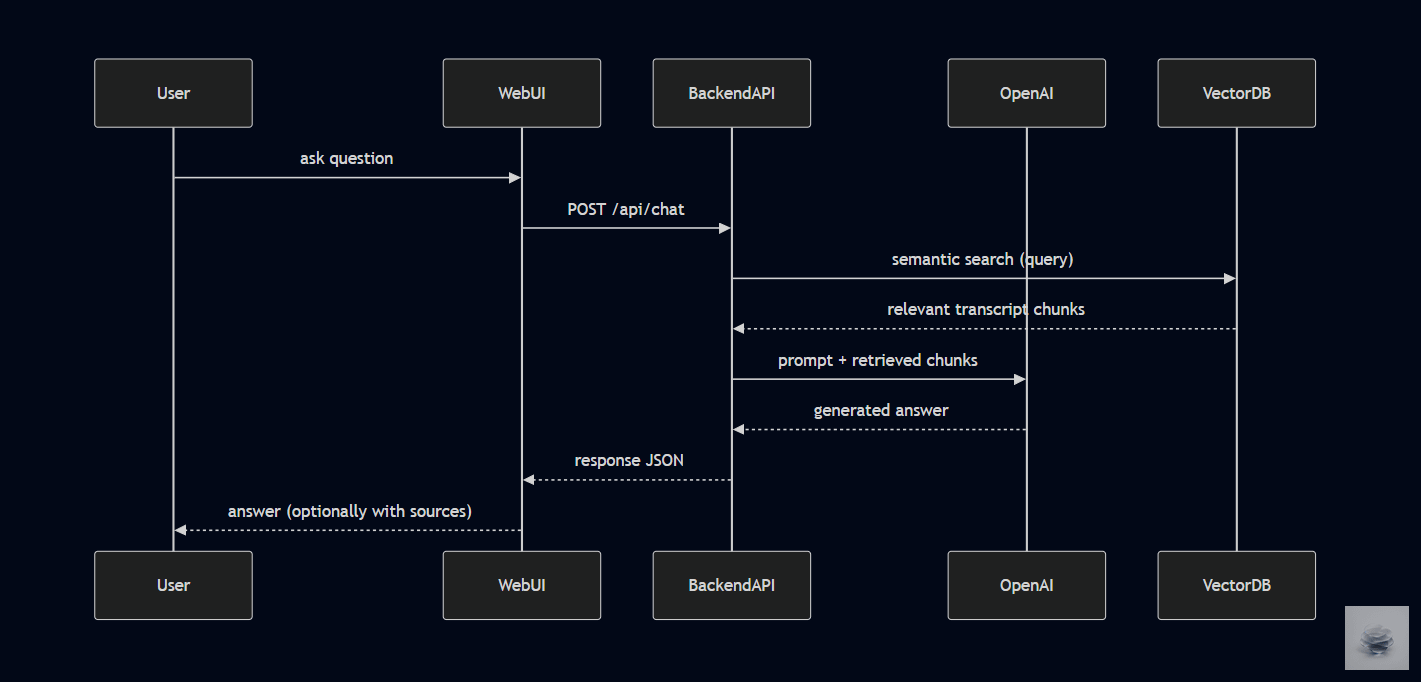
this made one thing clear. retrieval quality was not just important, it was dominant. when the retrieved material was strong, synthesis felt almost trivial. when retrieval was weak, no amount of prompting could compensate. the model was being asked to reason over inputs that were only loosely aligned with the question, and the results reflected that ambiguity.
none of these issues were about scale or performance. the dataset was manageable, latency was acceptable, and the system behaved exactly as designed. the problem was conceptual. vector search returns ranked text, not verified support. by passing those results directly into the reasoning step, the system implicitly asked the model to decide what counted as evidence and how much weight to assign to it.
at this point, it became clear that tuning retrieval alone would not be enough. adjusting thresholds, rebuilding the index, or experimenting with embeddings could improve results at the margins, but they did not address the underlying issue. retrieval was being treated as a background step, when in reality it was shaping the behavior of the entire system.
this was the point where the architecture needed to change. the problem was no longer how to retrieve better text, but how to make retrieval explicit, enforceable, and visible to the rest of the system. that realization set up the next shift in the design.
making retrieval explicit with an mcp server architecture
once it became clear that retrieval was shaping the system’s behavior more than anything else, the question stopped being how to tune it and started being how to control it. vector search was returning text, but the system had no clear boundary between text that was merely related and text that the model was allowed to treat as evidence. as long as retrieval stayed implicit, the model was being asked to make judgment calls it was not designed to make.
this is where introducing an mcp server changed the shape of the system.
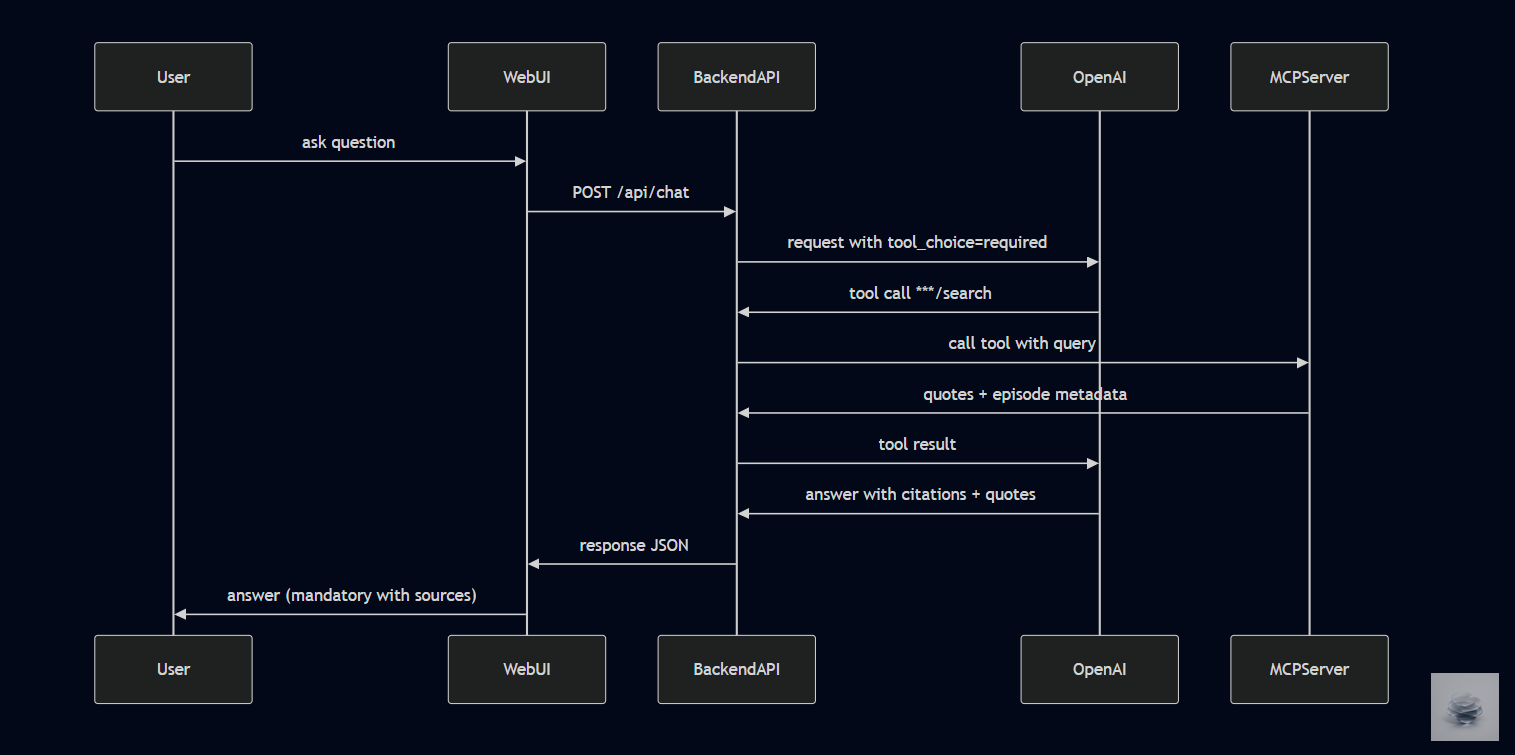
instead of retrieval happening inside application code and quietly feeding context into a prompt, it was moved behind an explicit interface. search became a tool that the model had to call deliberately, with a defined input and a structured output. the role of the mcp server was not to replace vector search, but to wrap it, enforce constraints, and make retrieval a visible part of the reasoning process rather than a hidden preprocessing step.
that shift had immediate consequences. the model could no longer receive arbitrary chunks of text “just in case” they were useful. it had to request quotes, and it had to work only with what the server returned. the retrieval step became legible. when answers were weak, it was clear whether the issue came from the query, the search results, or the synthesis itself. failures stopped being ambiguous.
this boundary also aligned naturally with the constraints defined earlier. because the mcp server returned only transcript-backed quotes, it became structurally impossible for the model to answer from anything else. the system no longer relied on prompt discipline or post-processing checks to avoid hallucinations. the architecture itself enforced the rule that answers must come from evidence.
introducing this layer might sound heavy for a small project built over a weekend, but in practice it simplified things. responsibilities were clearer, and debugging became more direct. retrieval was no longer something that happened before reasoning. it became something the reasoning process itself depended on.
at this point, ask lenny settled into a clear shape. it stopped behaving like a chat interface with search bolted on and started behaving like a research system, with explicit boundaries between questioning, retrieval, and synthesis. the diagram below shows that flow end to end, and how every handoff in the system is intentional.
forcing tool usage in retrieval-augmented generation
introducing an mcp server made retrieval explicit, but it did not automatically make the system reliable. the next issue showed up in how the model behaved when retrieval was technically available but not strictly required. when given the option, the model would sometimes try to answer directly, leaning on general knowledge or pattern completion instead of going through the search step every time.
that behavior was expected. large language models are optimized to be helpful, and skipping a tool call is often the fastest path to a fluent response. the problem was that fluency was no longer the goal. as long as retrieval remained optional, the system could still drift toward confident answers that were weakly grounded or not grounded at all.
the fix was blunt but effective. the model was forced to call the retrieval tool for every question. no search meant no answer. this removed an entire class of ambiguous behavior and replaced it with something much easier to reason about. either the transcripts contained relevant material and the system could respond, or they did not and the system would fail visibly.
forcing tool usage changed answer quality in a few important ways. variance dropped significantly. answers became more consistent across similar questions because they were anchored to the same underlying evidence. when answers were short or incomplete, it was usually because the source material was thin, not because the model was guessing.
this also changed how failures felt. instead of subtle inaccuracies, failures became obvious gaps. sometimes the system would return very little. sometimes it would surface quotes that were related but not sufficient to fully answer the question. those outcomes were not bugs. they were signals about the limits of the source material, and they made it easier to trust the answers that did exist.
there was a tradeoff here. forcing tool usage meant giving up the illusion that the system could answer anything. it also meant accepting that some user questions would not be satisfied. but for a research-oriented tool, that tradeoff was worth it. predictable failure turned out to be far more valuable than graceful speculation.
by this point, the system had a clear shape. retrieval was mandatory, evidence was explicit, and reasoning was constrained. what remained was to make the retrieval layer itself usable, especially given the messiness of long-form, conversational transcripts, which introduced its own set of challenges.
indexing spoken language and making retrieval usable
once retrieval was mandatory, its weaknesses became impossible to ignore. podcast transcripts are not clean documents. they are conversational, non-linear, and full of digressions. people interrupt each other, change direction mid-thought, and return to ideas minutes later. indexing this kind of material is very different from indexing blog posts or documentation.
the first challenge was chunking. chunks that were too small lost context and produced brittle matches. chunks that were too large buried relevant points inside unrelated discussion. finding a balance took iteration, and there was no single correct answer. different questions benefited from different chunk shapes, which meant accepting that retrieval would always be an approximation.
relevance was another issue. semantic similarity works well when text is tightly scoped, but conversational content often circles around a topic before landing on the point that matters. vector search would sometimes surface passages that were thematically related but weak as evidence. because the system now depended entirely on retrieved quotes, those weaknesses were immediately visible in the answers.
there were also practical failures. building the index led to memory crashes that required rebuilding it incrementally. small mistakes in metadata propagation made citations unreliable. fixing these issues was less about clever algorithms and more about respecting the shape of the data and testing assumptions repeatedly.
one clear lesson emerged from this phase. model choice mattered far less than retrieval quality. once the system was forced to reason only over retrieved evidence, improving the index produced larger gains than changing prompts or swapping models. the quality of answers rose and fell with the quality of the material they were allowed to see.
by the time this layer stabilized, the system was functionally complete. the remaining work shifted away from core architecture and toward everything that surrounds a real application, including deployment, debugging, and the user interface that made the system usable in practice.
failures, deployment issues, and debugging under real constraints
once the system worked end to end in a local environment, a different class of problems appeared. these were not conceptual issues about retrieval or reasoning, but practical failures that only surfaced once the system was deployed and exercised as a real application rather than a controlled experiment.
moving from local development to a deployed setup introduced friction immediately. assumptions that held in one environment, broke in another. ports did not line up the way i expected. environment variables behaved differently. requests that looked correct from the application layer would fail somewhere along the retrieval path without producing clear errors.
this was also the point where i developed a new respect for backend engineers. as a product manager, i’m used to reasoning about systems at a conceptual level. deployment has a way of turning that confidence into humility very quickly.
mcp integration added its own set of sharp edges. switching between communication modes led to situations where the server was technically running but not reachable in the way the model expected. tool names also mattered more than anticipated. a mismatch between the name exposed by the retrieval layer and the name referenced by the model resulted in tools that appeared available but were never actually called. nothing crashed. the system simply stopped retrieving evidence.
this became a recurring pattern. most failures did not surface as explicit errors. instead, the ui would render empty states, or the model would return generic responses with no citations. at first, these looked like model issues. in practice, they were almost always configuration or integration problems somewhere between the user input and the retrieval boundary.
debugging quickly became the dominant activity. logs mattered more than new features. testing system boundaries directly helped isolate where assumptions broke. inspecting network requests revealed subtle transformations that were easy to miss when everything was wired together. once i stopped assuming that any single layer was behaving correctly by default, progress became more predictable.
these failures reinforced an earlier lesson. in systems where retrieval is mandatory and evidence is constrained, correctness is fragile. small mismatches can have outsized effects. the upside is that once the system is wired correctly, behavior becomes much easier to reason about. failures stop being mysterious and start pointing directly to broken assumptions.
by the time deployment stabilized, the system was reliable enough to focus on something that initially felt secondary but turned out to be critical. how users interacted with the system, and how the interface communicated the system’s constraints and behavior, mattered almost as much as the architecture underneath it.
designing the ai interface and earning user trust
once the system was reliable enough to answer questions consistently, attention shifted to something that initially felt secondary but quickly proved decisive: how the system presented itself to the user. when answers are constrained, incomplete, or sometimes empty by design, the interface does a lot of the explanatory work that the system itself cannot.
this was especially true for the input. the chat box was not just a place to type a question. it was the primary signal of what kind of system this was. a large, open-ended editor encourages exploratory behavior and casual prompts. a tighter input pushes users toward more deliberate questions. i chose a single-line input by default, not because it was simpler, but because it subtly suggested that this was a research query, not a conversation.
shift+enter to expand into a multi-line editor became an explicit signal of intent. it told the system, and the user, that this question required more thought. small design details in the user interface mattered more than i expected. when answers are grounded and sometimes sparse, visual balance affects how confident the system feels. a cramped interface makes uncertainty feel like failure. a calm layout makes it feel like an honest limitation.
citations played a similar role. showing quotes alongside answers changed how people read the output. instead of evaluating whether the answer sounded right, users evaluated whether the evidence made sense. that shift is important. it moves trust away from learned fluency and toward inspectable source material. even when the answer was short, the presence of citations made it clear why it existed.
there was also an acceptance baked into the interface that some questions would not be answered well. the system does not apologize excessively or try to soften those moments. it simply shows what it found. this turned out to be more reassuring than expected. users are used to ai systems that always respond, even when they should not. a system that occasionally returns very little, but explains itself implicitly through evidence, feels more predictable.
as a product manager, this was one of the more surprising lessons. trust did not identify itself as a feature, but it behaved like one. small interface decisions amplified or undermined everything the system was doing underneath. once retrieval and reasoning were constrained, the ui became the layer where those constraints were either communicated clearly or misunderstood entirely.
by the end of this phase, the system felt complete enough to reflect on. not in the sense that it was finished, but in the sense that its shape was clear. what remained was to step back and understand what this experiment revealed about building retrieval-first ai systems, and what i would change if i were to do it again.
what surprised me while building a retrieval-first ai system
by the time the system felt stable, a few patterns had emerged that i did not expect going in. none of them were about clever prompting or model choice. most of them were about how systems behave once you remove their ability to improvise.
the biggest surprise was how little the language model mattered once retrieval was enforced properly. changing models or prompts produced marginal improvements at best. improving retrieval quality, chunking, or evidence selection produced immediate and visible gains. once the model was forced to reason only over retrieved quotes, its role narrowed naturally to synthesis rather than generation.
another surprise was how often systems fail quietly. when retrieval breaks, the system does not always crash. it often produces something that looks reasonable but is subtly wrong or empty. these failures are harder to detect than obvious errors, especially if you are used to ai systems that always return something. making failure visible turned out to be more important than making success impressive.
constraints also turned out to be clarifying rather than limiting. removing the option to answer freely simplified many decisions downstream. there was less debate about edge cases and fewer ambiguous behaviors to reason about. once the rules were explicit, the system became easier to debug and easier to trust, even when it returned incomplete answers.
the last surprise was how much trust depends on predictability. users were more comfortable with a system that sometimes failed clearly than with one that always responded confidently. grounded answers, even when short, felt different from fluent answers backed by nothing. that difference is hard to quantify, but it shows up quickly once you start using the system for real questions rather than demos.
these observations changed how i think about ai products more broadly. intelligence is often framed as the ability to answer more questions. in practice, usefulness often comes from knowing when not to answer at all. this project made that tradeoff concrete in a way that theory never did.
with that perspective in place, it was easier to see what i would do differently if i were starting again, now that the system’s real constraints and failure modes were visible.
what i would do differently if i built this again
building this over a weekend was useful because it forced decisions, but it also created blind spots that only became obvious later. if i were starting again, with the benefit of having seen the system behave under real use, there are a few things i would change.
the first is observability. i underestimated how much visibility a retrieval-first system needs. logs existed, but they were not designed around questions like why a particular quote was retrieved, why another was ignored, or why an answer ended up empty. adding structured visibility around retrieval inputs, tool calls, and synthesis decisions earlier would have shortened debugging cycles and made failures easier to reason about.
i would also simplify earlier. some complexity crept in before it earned its place, especially around configuration and integration glue. none of it was conceptually hard, but each additional moving part increased the surface area for silent failure. with hindsight, i would aim for fewer abstractions up front and introduce structure only once the system proved it needed it.
another area where i would be more intentional is the user interface. there is a version of ask lenny that is visually richer, more expressive, and more obviously delightful to look at. i could see that version clearly while building. but given the time constraint and the desire to get something real into users’ hands, i drew a hard boundary. the interface needed to be clear, honest, and functional, not polished to the point of analysis paralysis. shipping a restrained ui made it possible to validate the system’s behavior without hiding problems behind visual gloss.
that decision was correct for this phase, but it is still a tradeoff. once the core behavior is trustworthy, a richer interface becomes more than decoration. it can help users explore, compare, and reason more effectively. if i were rebuilding this with more time, i would invest earlier in interface experiments that enhance comprehension without undermining the system’s constraints.
i would also invest in retrieval evaluation sooner. a lot of iteration happened by reading answers and judging whether they felt right. that works at small scale, but it is fragile. even lightweight checks, such as validating that retrieved quotes actually support the claims being made, would have made improvements more systematic and less intuitive.
none of these changes would alter the core idea of the project. they are refinements, not reversals. the central insight, that constrained, evidence-first systems behave differently and often better than fluent ones, held up throughout. the difference is that seeing where the system breaks gives you a clearer sense of where to draw boundaries, and where to push next time.
conclusion
building ask lenny clarified something i had mostly understood in theory but not fully internalized in practice. ai systems feel powerful when they can say a lot, but they become useful when they know exactly what they are allowed to say and, just as importantly, what they are not.
treating retrieval as a first-class concern changed the shape of the entire system. once answers were forced to come from evidence, many common ai tricks stopped being relevant. model choice mattered less. prompt cleverness mattered less. what mattered was the quality of the source material, the reliability of retrieval, and the clarity of the boundaries between components.
building this over a weekend amplified those lessons. there was no room for abstract debates or perfect architectures. decisions had to survive contact with real behavior. things broke quickly, and when they did, they revealed where assumptions were wrong. that pressure made it easier to separate what was essential from what was decorative.
ask lenny is not a finished product, and it was never meant to be. it is a concrete example of how retrieval-first, evidence-constrained systems behave differently from generic chat interfaces. grounded answers feel different to use. predictable failure feels more trustworthy than fluent speculation. those differences only become obvious when you build and use a system like this end to end.
the broader takeaway is not about podcasts or transcripts specifically. it is about designing ai systems that are meant to support thinking rather than replace it. when the goal is reasoning, reference, and inspection, constraints are not limitations. they are the structure that makes the system usable at all.
if you want to see how this behaves in practice, you can try ask lenny using the link below.
ask lenny v2 is now live with a calmer interface, a more focused input experience, and improved interaction details.
faqs: common questions about ask lenny
what is ask lenny, exactly?
ask lenny is a web-based ai research assistant that answers questions using only direct quotes from lenny rachitsky’s podcast transcripts, with citations back to the original episodes. it does not generate advice independently or summarize content without evidence.
how is this different from a typical ai chatbot?
most chatbots optimize for fluency and coverage. ask lenny optimizes for grounding and traceability. if the transcripts do not contain relevant material, the system should not answer.
why use podcast transcripts instead of written content?
podcasts capture reasoning, tradeoffs, and context that are often lost in polished writing. transcripts preserve that richness while making the content searchable and referenceable.
what is vibe coding and how did it apply here?
vibe coding refers to building quickly with ai-assisted tools like cursor, prioritizing momentum and real behavior over perfect abstractions. in this project, it made it possible to iterate fast and surface architectural issues early.
what role does mcp play in the system?
the mcp server acts as a retrieval boundary. it exposes transcript search as an explicit tool that the model must call, making retrieval enforceable, inspectable, and constrained.
why force the model to use retrieval tools every time?
optional retrieval leads to ambiguous behavior. forcing tool usage ensures that every answer is anchored in evidence and that failures are visible rather than hidden behind confident language.
is this an example of rag? how does it relate to typical rag systems?
most people would describe this as an example of rag (retrieval-augmented generation), but with stricter constraints than many rag systems in the wild.
typical rag setups often treat retrieval as a suggestion: the model gets some context and can still hallucinate around it. in ask lenny, retrieval is a gate. if the system cannot find relevant evidence in the transcripts, it should not answer at all.
that means the model is not only using context; it is being forced to respect the boundary between what the corpus actually says and what it would like to infer. in practice, this makes the system less magical in demos but much more trustworthy for research questions.
who is this kind of system useful for?
people who use content as input for thinking rather than inspiration. product managers, founders, researchers, and readers who want to stay close to original reasoning and cite sources accurately.
would you recommend building something like this?
yes, especially if you want to understand retrieval-augmented generation, mcp, and evidence-first design in practice. building a constrained system exposes different failure modes than building a fluent one, and those lessons transfer well to more complex ai products.
Didn't expect such power from well-structurd podcast data.