

in ai products, launch readiness cannot be determined by qa sign off or feature completion. product managers must evaluate system reliability, error impact, and user verification before release. this article presents a decision framework for determining whether an ai feature is ready for production and how to judge acceptable failure behavior.
introduction
product managers are increasingly asked a question that used to belong to engineering: can we ship this?
in traditional software, that question had a clear meaning. qa validated the feature. bugs were logged. acceptance criteria were checked. if the system matched its specification and critical issues were resolved, the feature was considered ready.
ai changes that agreement.
an ai feature can pass tests and still fail in production. it can behave correctly in staging and unpredictably with real users. more importantly, it can be simultaneously useful and incorrect. users may complete tasks faster while still receiving wrong outputs at a non trivial rate. this creates a launch ambiguity most product teams are not prepared to evaluate.
the core problem is simple. product managers are expected to approve launches for systems whose behavior cannot be verified in the traditional sense. deterministic software can be validated against known outputs. probabilistic systems cannot. the relevant question is no longer “does it work”.
the new relevant question is “does it work reliably enough for this use case and its associated risk”.
teams feel this tension immediately in launch meetings. engineering reports strong model performance. design demonstrates clear user value. leadership wants to move quickly. yet no one can define a readiness threshold. the absence of a shared standard leads to two predictable outcomes. teams either delay shipping while waiting for certainty that will never arrive, or they ship based on intuition and discover failures through users.
neither approach scales.
ai launches require a different decision framework. the pm is not signing off on feature completion. the pm is making a risk judgment about system behavior under uncertainty.
the framework in this guide is a mental model for making that judgment. it does not explain how to build ai features. it defines how to decide whether one should be released.
why ai feature launch decisions are harder than traditional software releases
deterministic software made release decisions simple because correctness could be defined in advance.
a billing calculator either computes the invoice total correctly or it does not. a permission system either blocks access or allows it. a search filter either returns items that match the query or it contains a bug. software behavior was the execution of logic that humans explicitly wrote. verification meant checking whether the system followed its rules.
because of this property, release decisions were binary. once test coverage and qa validation confirmed that expected outputs matched actual outputs, the feature was considered complete. risk still existed, but it was operational risk such as scale, performance, or edge cases. it was not behavioral uncertainty.
ai systems change the nature of the decision because they do not execute explicit logic. they approximate patterns learned from data. their outputs are not guaranteed consequences of rules. they are statistical predictions.
a language model producing a summary is not retrieving a stored answer. it is generating a plausible answer. a classifier assigning a support ticket category is not verifying a known truth. it is estimating likelihood. even when accuracy is high, the system can still produce confident errors that look legitimate.
this destroys the binary concept of “working software.”
an ai feature is rarely either correct or broken. instead, it operates across a distribution of outcomes. some outputs are correct. some are acceptable. some are wrong but harmless. some are wrong and harmful. the system can be useful while still being unreliable in specific situations.
therefore the launch decision cannot be a correctness verification. it becomes a risk management decision.
the pm is not deciding whether the feature is finished. the pm is deciding whether the behavior of the system is safe and useful enough for real-world users interacting in uncontrolled conditions. this is a fundamentally different responsibility.
feature completion means the experience exists and functions. ai readiness means the failure profile is understood and acceptable.
this distinction matters because teams often try to apply traditional release reasoning to ai. they wait for higher accuracy scores, more prompt tuning, or additional testing data, expecting a moment when the system becomes stable. that moment does not arrive. probabilistic systems do not converge to certainty. they converge to predictable unreliability.
once this is understood, the launch conversation changes. the relevant discussion is no longer about whether the model performs well in isolation. the discussion becomes about how often it fails, how visible those failures are to users, and what happens when it is wrong.
ai launches are not feature launches. they are reliability launches.
ai product launch checklist: a reliability evaluation framework for product managers
a pm approving an ai launch is not evaluating the model itself. the pm is evaluating the interaction between the model, the user, and the consequence of error. reliability is contextual. the same system can be safe in one product and unacceptable in another.
the goal of the framework is to make that context explicit before release. a launch decision becomes defensible only when the team understands what kind of task the ai performs, what happens when it fails, and who absorbs the cost of that failure.
use the following evaluation checklist before shipping:
task type
user error detectability
cost of being wrong
failure accumulation
human oversight requirement
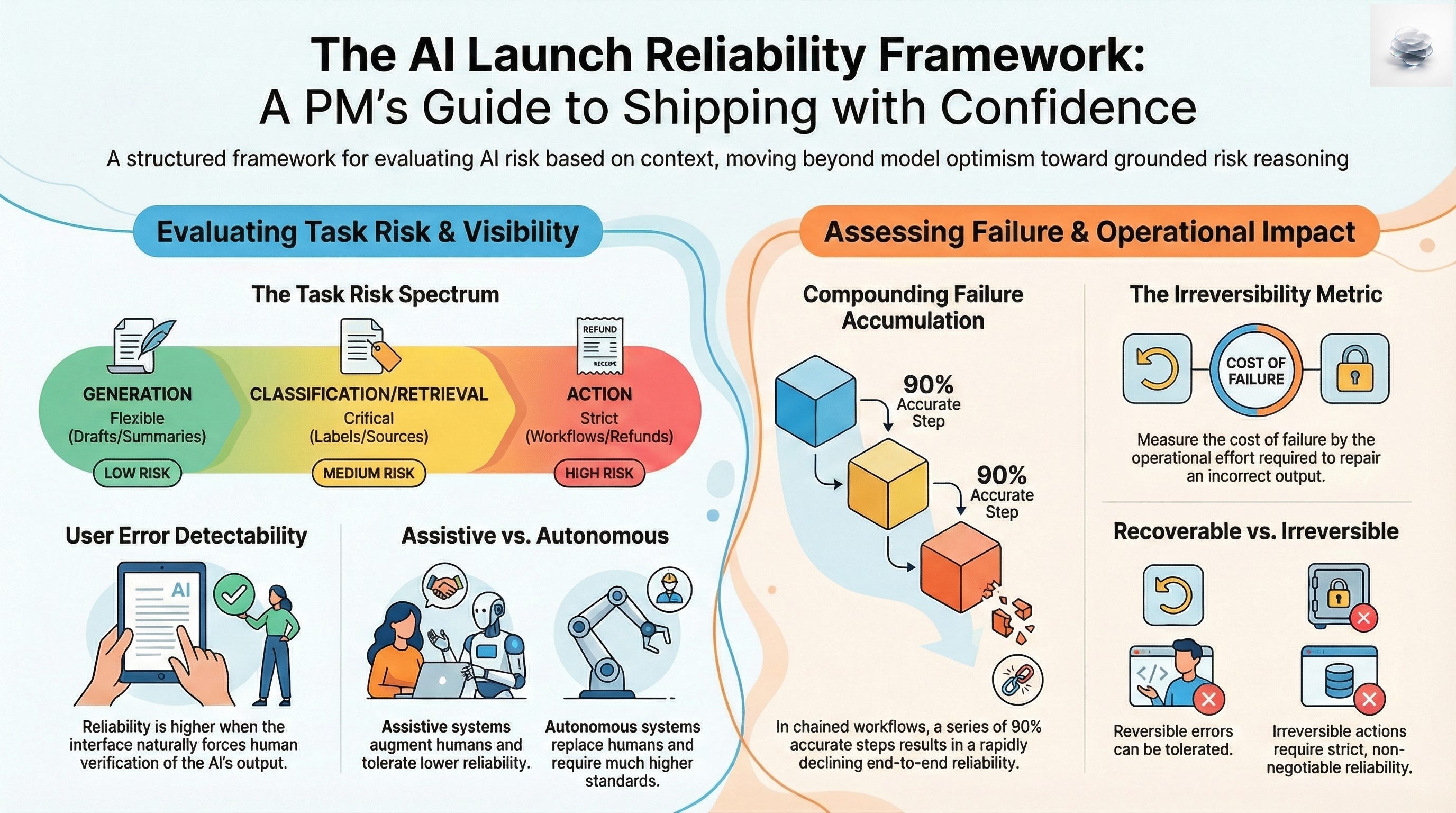
task type (what the ai is actually doing?)
ai features look similar on the surface but behave very differently depending on the category of task.
generation produces new content such as drafts, summaries, and suggestions. correctness is flexible because multiple outputs may be acceptable.
classification assigns labels such as spam detection, ticket routing, or intent recognition. correctness matters more because downstream systems depend on the label.
retrieval finds existing information. reliability depends on whether the system returns the right source, not on creativity.
action performs an operation such as sending a message, modifying data, issuing a refund, or executing a workflow. this is the highest risk category because the model changes state in the real world.
shipping confidence decreases as you move from generation to action. teams frequently underestimate this because the interface looks identical. a chat box that drafts an email and a chat box that edits a customer account appear similar to users, but their risk profile is entirely different.
before launch, the pm should explicitly identify which category the feature belongs to. many launch mistakes occur because teams treat an action system as if it were only a generation tool.
user error detectability (can the user notice mistakes?)
reliability is strongly influenced by whether users can verify outputs.
if a writing assistant produces a rough draft, the user reads it. errors are naturally caught because the user is already reviewing the content. the product benefits from a built in verification layer.
contrast this with an automated categorization system that silently routes support tickets. the user never inspects the label. an error is invisible until it creates a downstream problem.
the key question is not model accuracy. the key question is whether the interface forces human verification.
systems where users naturally review outputs can tolerate lower reliability. systems where users trust the system without inspection require significantly higher reliability.
many ai failures are product design failures. the model did not suddenly become worse in production. the system relied on users to detect mistakes that the interface prevented them from seeing.
cost of being wrong (who pays for failure?)
every ai system fails. the only meaningful question is what happens when it does.
if a summary tool omits a detail, the cost is minor. the user still has the original document. the failure is recoverable.
if a financial assistant miscalculates a payment or an automated support agent issues incorrect refunds, the cost becomes operational and financial. recovery now requires human intervention and damages trust.
this cost is not measured by inconvenience. it is measured by irreversibility. reversible errors can be tolerated. irreversible actions require strict reliability.
a useful exercise before launch is to map the worst plausible incorrect output and ask what operational process is required to repair it. if repair requires a support team, a refund, or a manual audit, the feature is operating in a high risk zone.
failure accumulation (do errors compound across steps?)
some ai features operate in isolation. others are part of a chain.
a single incorrect suggestion in a drafting tool affects only that output. but consider a system that classifies a ticket, retrieves knowledge base articles, generates a response, and sends it automatically. each step depends on the previous one.
in chained systems, small errors compound. a 90% accurate step followed by another 90% accurate step does not create a 90% reliable system. it creates a system where the probability of a fully correct outcome drops quickly across the workflow.
teams often evaluate each component independently and conclude that performance is acceptable. users experience the combined reliability of the entire chain.
launch readiness should therefore be evaluated at the workflow level, not the model level. the question is whether the end to end behavior produces acceptable outcomes consistently.
human oversight requirement (should a human remain in the loop?)
human involvement is not a safety checkbox. it is a product design choice.
the decision is economic. if a human must review every output carefully, the productivity gain from automation may disappear. however, removing humans too early shifts the burden of error to users and support teams.
a pm should decide whether the system is assistive or autonomous. assistive systems augment human work and tolerate lower reliability because humans validate outputs. autonomous systems replace human decisions and require much higher reliability.
many successful ai products begin as assistive systems and gradually automate portions of the workflow as confidence increases. premature autonomy is one of the most common sources of failed ai products.
this framework does not produce a numeric threshold. it produces clarity. once these five dimensions are understood, the launch decision becomes grounded in risk reasoning rather than model optimism.
defining acceptable ai reliability: how product managers decide “good enough” accuracy
teams often ask for a target accuracy number before launch. this instinct comes from traditional software quality thinking. it assumes that there exists a universal threshold where the system becomes ready.
there is no universal number.
ai systems do not fail in a uniform way, and correctness is not a single dimension. a model with 95% accuracy can be unsafe, while a model with 70% accuracy can be valuable. readiness depends on what the system is allowed to influence and how users interact with it.
the mistake is evaluating reliability in isolation. reliability only has meaning relative to consequence.
consider drafting assistance. a writing tool that produces imperfect summaries still reduces user effort because the user reads and edits the output. the human acts as a verification layer. the acceptable failure rate is therefore high. the system is helpful even when it is wrong often, because the cost of correction is low and the original information remains visible.
now consider automated decision support. if an ai system approves refunds, changes account status, or provides financial guidance, the user may not double check it. the output directly changes reality. the acceptable failure rate drops dramatically, not because the model changed, but because the product role changed.
this is the core shift for pm judgment. reliability is not measured by model accuracy. it is measured by the tolerated error in the context of user trust and operational impact.
a useful way to reason about this is to think in terms of error budgets. not engineering error budgets tied to uptime, but behavioral error budgets tied to consequence. every product implicitly allows a certain number of incorrect outcomes before trust erodes or operational costs rise.
low consequence features can tolerate frequent mistakes because users expect imperfection. suggestions, brainstorming, drafting, and exploratory search all fall into this category. users treat the system as assistance rather than authority. the value comes from acceleration, not correctness.
medium consequence features require visible verification. routing recommendations, prioritization hints, and decision support tools are useful only when users can inspect and override outputs easily. here the system must be right most of the time, but occasional errors are acceptable because users remain engaged in evaluation.
high consequence features have minimal tolerance for incorrect behavior. transactions, compliance decisions, identity verification, or legal and financial outputs create external impact. in these cases, the model does not just inform a decision. it performs or triggers a decision. even a small failure rate produces outsized cost because users and organizations assume correctness.
this explains why teams feel stuck waiting for “one more improvement.” they are trying to achieve certainty in a probabilistic system. readiness is not achieved when the model becomes perfect. readiness is achieved when the observed failure pattern fits within the acceptable consequence boundary of the product.
in practice, this means a pm should not ask whether the system is accurate enough in general. the pm should ask whether the current failure behavior is tolerable for the specific job the product assigns to the ai.
ai features do not become ready when they stop failing. they become ready when their failures are survivable.
when ai products need human review: deciding human in the loop vs automation
human review is often discussed as a safety mechanism. in product development it is primarily an economic mechanism.
an ai system creates value only if it changes the cost structure of completing a task. automation reduces labor. assistance reduces effort. however, supervision introduces a new cost. the presence of a human in the loop is justified only when it changes the balance between productivity and risk in a favorable way.
the mistake many teams make is treating human review as a temporary step before full automation. they assume that the goal of the product is autonomy and that human oversight is merely a bridge. in practice, many successful ai features remain permanently assistive because that configuration produces the best economic outcome.
consider a drafting assistant. a user reads the generated text anyway because sending incorrect communication carries reputational cost. the review step does not meaningfully add effort. the human was already required. the ai saves time while the human provides validation. assistance works because verification overlaps with normal user behavior.
contrast this with a system that generates and sends customer support replies automatically. if the company must now employ agents to audit every outgoing message carefully, the automation benefit disappears. the organization now pays both the model cost and the human cost. productivity has not increased. it has shifted.
human review should therefore be introduced when it prevents expensive failures without recreating the original workload.
there are clear situations where human oversight is required before launch. whenever the system performs an irreversible action, modifies user data, moves money, or communicates externally on behalf of a person or company, the product has entered a trust boundary. users and organizations assume intentionality behind those actions. errors are interpreted as decisions, not glitches.
in those cases, review is not about improving model performance. it is about preserving accountability. a human reviewer converts the system from an autonomous actor into a decision support tool. responsibility remains visible and controllable.
however, excessive supervision can also eliminate product value. if users must carefully check every token of a generated output or manually redo the work to be safe, the feature becomes slower than the original workflow. the product has added cognitive load instead of removing it.
the pm’s task is to locate the boundary where oversight reduces catastrophic risk but does not negate the speed advantage created by the ai. this boundary is different for each workflow and must be evaluated through real-world task observation, and not internal testing alone.
in many cases the correct design is staged autonomy. the system begins as a recommendation, progresses to pre-filled actions requiring approval, and only later performs limited automatic actions in well understood situations. the progression is driven by observed reliability and operational comfort, not by a belief that full automation is inherently superior.
human in the loop is therefore not a maturity phase. it is a product configuration choice tied to accountability, user trust, and cost structure.
ai product metrics that matter: measuring reliability instead of engagement
product teams are accustomed to evaluating features through adoption and engagement. usage increases, session time grows, and retention improves. those signals are useful for conventional software because behavior reflects utility. when a feature works, users rely on it.
ai features break this assumption.
users can heavily use an ai system that is frequently wrong. they use it because it is fast, not because it is correct. the cost of verification is often deferred. the user accepts the output, moves forward, and only discovers the error later. engagement therefore measures convenience, not reliability.
this is why many teams launch ai features that appear successful for months and then suddenly generate support load or trust issues. the product was optimized around interaction rather than outcome. reliability problems accumulated with time.
to evaluate readiness and ongoing health, the pm must monitor behavioral reliability signals rather than surface activity. the following metrics reflect whether the system is actually working in real-world user workflows:
correction rate
user verification behavior
escalation frequency
task completion success
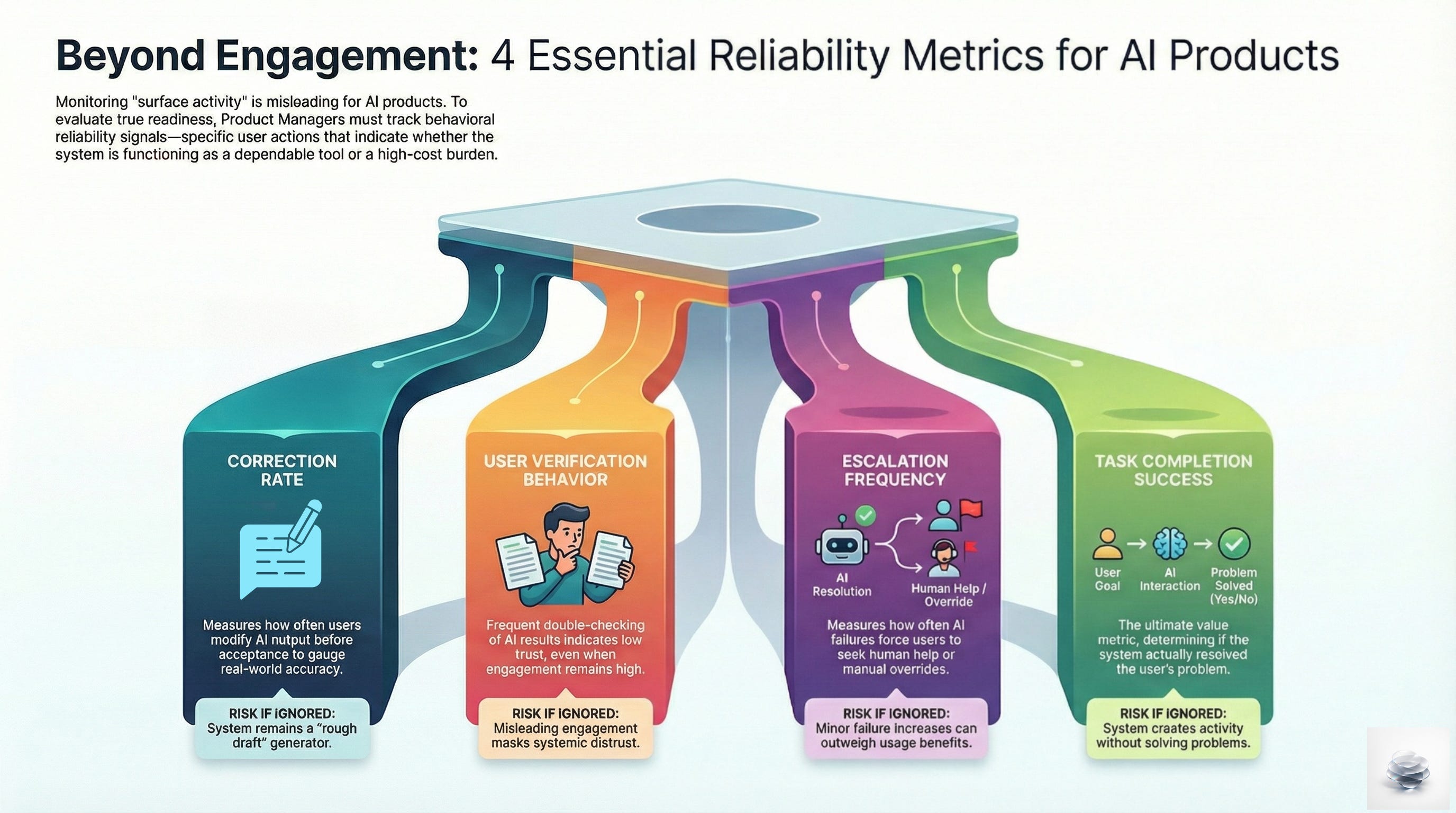
correction rate measures how often users modify the ai output before accepting it. this is one of the clearest indicators of real world accuracy. if users consistently rewrite or fix results, the system is acting as a rough draft generator, not a dependable tool. a moderate correction rate may be acceptable in assistive features, but a high rate in decision making workflows signals unreliable behavior.
user verification behavior captures whether users feel compelled to double check the system. examples include opening source documents after reading summaries, re-checking calculations externally, or repeating queries with slightly different wording. frequent verification indicates low trust. importantly, this often appears alongside high engagement, which is why engagement alone is misleading.
escalation frequency measures how often users seek human help after interacting with the ai. support tickets, manual overrides, or staff intervention reveal when the system fails in ways users cannot resolve alone. even a small increase here can outweigh strong usage metrics because escalations represent operational cost.
task completion success evaluates whether the user actually finishes the intended job. the purpose of a support reply generator is not message creation. it is issue resolution. if customers contact support again after receiving an ai generated response, the system created activity without solving the problem. completion success is the closest measure of your product value.
engagement metrics still matter, but they must be interpreted cautiously. high usage with high correction and escalation is not product market fit. it is dependency on a flawed tool. users continue because it is convenient, while absorbing hidden costs.
ai features should therefore be monitored similarly to reliability systems rather than growth features. the pm is no longer measuring how much the feature is used. the pm is measuring how often the system behaves acceptably when relied upon.
conclusion
the reliability guide explained that ai systems introduce behavioral uncertainty into software. the evals article argued that evaluation becomes a permanent layer in ai products rather than a one time testing phase. together they imply a change in responsibility for product managers.
shipping ai features is not a matter of feature completion. it is a matter of controlled risk.
traditional software allowed pm decisions to be based on specification fulfillment. if the feature met requirements and passed qa, release was justified. ai systems cannot be validated that way because their behavior is not fully predictable. they can perform well overall while still failing in specific interactions that matter operationally.
this is why launch readiness must be framed as a reliability judgment. the pm evaluates the task type, the visibility of errors, the consequence of mistakes, the accumulation of failures across workflows, and the role of human oversight. the decision is not whether the model works in general. the decision is whether its failure pattern is acceptable inside the product’s trust boundary.
after launch, the responsibility continues. reliability metrics replace traditional feature metrics. correction behavior, verification patterns, escalation rates, and completion outcomes indicate whether the system is behaving responsibly in production conditions.
over time, this changes how product management itself functions. the pm becomes less focused on delivering discrete features and more focused on managing ongoing system behavior. releases do not mark completion. they mark the beginning of observation.
ai products are not static capabilities. they are behavioral systems interacting with unpredictable users and environments. managing them requires continuous evaluation, gradual autonomy decisions, and careful monitoring of real-world consequences.
in that sense, ai product management is a shift in discipline. the job moves closer to operational risk management. the pm is responsible for deciding when a system can be trusted, how much it can be trusted, and how that trust evolves.
for deeper context, see ai product reliability: a guide for product managers, why ai evals are becoming the most important layer in ai products, the launch framework in how to evaluate ai product readiness, and the interface and workflow patterns in ai product design for product managers.