

ai product reliability refers to the degree to which an ai-powered product produces outputs that are consistently useful, appropriate, and safe for real-world user workflows under real-world usage conditions. reliability here does not mean correctness in a strict mathematical sense. instead, it describes behavioral stability: users can depend on the system without needing to constantly double check it. this maps closely to how trustworthy ai frameworks describe technical robustness and reliability.
this differs from traditional software because ai systems are probabilistic software. classical software executes explicit instructions. given the same inputs, it produces the same outputs. language models and similar systems instead generate outputs from statistical prediction. they estimate likely tokens rather than executing precise logic. identical prompts may yield different responses, and reasonable inputs may produce unreasonable outputs. the system is functioning as designed, yet the user experience may still fail.
this matters specifically to product managers because most established product development practices assume deterministic behavior. metrics, qa processes, and release validation frameworks were designed for software where errors are exceptional events. in ai product management, unreliable outputs are not rare edge cases but normal operational characteristics that must be managed as a product property.
this guide explains how to reason about ai product reliability as a system-level concept. it covers what an ai product actually contains beyond the model, how probabilistic behavior alters testing assumptions, why demonstrations misrepresent real-world usage, how user trust forms and collapses, how ai evals differ from testing, and why reliability becomes the primary driver of retention and growth when shipping ai products.
who this guide is for
product managers, engineers, and founders shipping ai products into real workflows.
teams struggling with “it works in the demo but not in production”.
people trying to connect ai reliability, ai evals, and retention into one mental model.
tldr: this is a system-level guide to ai product reliability; what an ai product actually is beyond the model, why probabilistic behavior breaks classical testing, how evals fit in, and why reliability becomes the main growth driver once you ship.
what an ai product actually is (beyond the model)
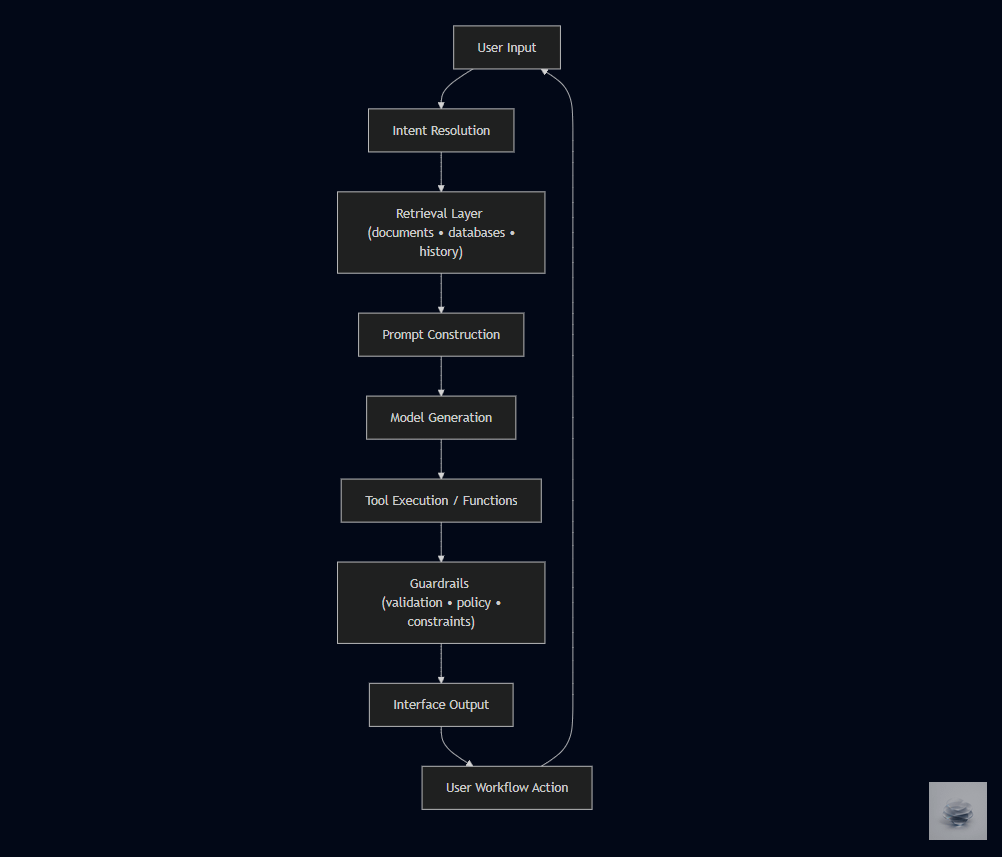
an ai product is not the model. the model is only the generation engine within a larger interaction system. treating the model as the product leads to incorrect design decisions, incorrect ai product metrics, and incorrect expectations about reliability. an operational ai system is a pipeline in which multiple components jointly determine the user experience.
the process begins with user input. the user does not provide a clean prompt. they provide ambiguous intent expressed in natural language, partial context, and implicit expectations shaped by previous software. the product layer must interpret the request, classify it, and determine which internal workflow to trigger. this step is frequently called intent resolution. failures here appear to users as “the ai did not understand me,” even when the model itself is functioning normally.
after intent resolution, most production systems include retrieval. the system gathers contextual information before the model generates an answer. this may include documents, database rows, previous conversations, structured business data, or external tool responses. the retrieval layer determines factual grounding. if incorrect or irrelevant context is retrieved, the model will confidently produce incorrect outputs. the model is predicting text conditioned on context, not verifying truth. therefore reliability is strongly dependent on retrieval quality rather than model capability.
prompt construction follows retrieval. the final prompt sent to the model is assembled by software, not written by the user. system instructions, formatting rules, safety policies, role definitions, and retrieved data are combined into a structured instruction. this is the real specification for llm product design. small variations in prompt structure can significantly change output behavior because the model interprets instructions probabilistically rather than logically.
generation occurs next. the model produces candidate outputs token by token based on probability distributions. temperature, sampling strategy, and context window constraints influence the result. importantly, the model does not “decide” correctness. it produces a statistically plausible continuation conditioned on the prompt and context. reliability cannot be enforced inside the model alone because generation has no internal concept of product goals.
many ai agents product design systems then execute tools. the model may call functions, write database queries, perform calculations, or interact with external services. tool execution introduces a second failure mode: the model may select an incorrect tool or provide malformed parameters. even if the generated text appears reasonable, the underlying action may be wrong.
guardrails operate after generation or after tool use. these include policy filters, safety classifiers, structured output validators, and business logic constraints. guardrails attempt to reject harmful, nonsensical, or non-compliant outputs. they do not make the model smarter; they bound the behavior of the system around the model.
finally, the product renders the output to the user. presentation decisions affect perceived reliability. formatting, citations, latency, and streaming behavior shape whether the user interprets the system as confident, careful, or erratic. a well-formatted answer with citations is trusted more than a textually identical answer without structure.
therefore an ai product is a coordinated system consisting of input interpretation, retrieval, prompt construction, generation, tool use, guardrails, and interface rendering. the model is only one component and often not the primary determinant of ai product reliability. shipping ai products requires managing interactions between these layers rather than focusing exclusively on model capability.
deterministic vs probabilistic systems
traditional software systems are deterministic. a deterministic system follows explicitly defined logic paths. a function receives structured input, executes programmed rules, and returns a predictable output. if the same inputs are provided again, the output remains identical. bugs therefore represent deviations from intended behavior. debugging consists of locating incorrect logic, missing conditions, or invalid state transitions.
quality assurance practices evolved around this assumption. test coverage attempts to enumerate edge cases. unit tests validate functions. integration tests validate component interaction. once a test suite passes, product managers can assume stable behavior across users because the software executes instructions rather than interpreting meaning. this is the world assumed by most classical definitions of product reliability in traditional engineering literature.
language models operate differently. a language model is a probabilistic next token predictor. it estimates a probability distribution over possible continuations of text conditioned on the prompt and context. generation is sampling from that distribution. the system therefore does not “execute” instructions. it interprets them statistically. instructions influence probability, not behavior guarantees.
this has direct implications for llm product design. two identical prompts can produce different outputs because sampling selects different high probability continuations. a correct output does not imply future correctness, and an incorrect output does not imply a system failure in the traditional sense. the model behaved according to its training distribution.
classical testing assumptions therefore break. a passing test case does not prove reliability. it proves that the model produced an acceptable output once. repeated execution may produce alternative outputs. coverage is also undefined. in deterministic software, inputs can be categorized into finite cases. natural language inputs are effectively unbounded. users continually invent new phrasing, ambiguous instructions, and unexpected contexts.
this creates a shift in ai product management. reliability is no longer binary. it becomes statistical. the product manager is managing output distributions rather than verifying rule execution. instead of asking whether the system works, the relevant question becomes how often it behaves acceptably across representative usage.
another difference is failure visibility. deterministic failures are typically explicit: crashes, error codes, or rejected requests. probabilistic failures are silent. the system produces fluent output that appears correct but is wrong or irrelevant. these failures propagate into user workflows because they are not detectable by interface alone.
as a result, shipping ai products requires new ai product metrics. success cannot be measured only by uptime, latency, or request success rate. a request can complete successfully while still damaging trust. reliability must therefore be evaluated behaviorally: whether outputs remain usable across real inputs, not whether the service responds.
probabilistic software is not broken software. it is a different class of system. managing it requires measuring patterns of behavior rather than verifying individual executions.
why ai product demos lie about reliability
ai product demonstrations rarely represent real-world usage conditions. a demonstration is a curated interaction designed to highlight system capability. production usage is an uncontrolled interaction space defined by diverse users, inconsistent inputs, and varied expectations. the gap between these two environments produces a predictable reliability shock when shipping ai products.
demonstrations operate under sampling bias. the presenter selects prompts known to work well. these prompts align with the training distribution of the model and with the assumptions embedded in the prompt design. they are syntactically clear, semantically specific, and contextually appropriate. real-world users do not behave this way. users provide incomplete requests, conflicting instructions, copied text fragments, domain jargon, and ambiguous intent. the model is therefore evaluated against a much broader input distribution in production than in a demo.
curated prompts also conceal retrieval limitations. during a demonstration, the system is often provided ideal context. documents are clean, relevant, and formatted correctly. production data is noisy. enterprise databases contain outdated records, duplicated entities, partial fields, and inconsistent terminology. retrieval systems must operate under imperfect information. the resulting outputs may be plausible but grounded in incorrect context. the model appears to hallucinate, yet the actual failure originated in the system’s data layer.
another difference is usage frequency. a demo involves a small number of interactions. reliability problems scale with repetition. a system that fails 5% of the time appears impressive in a short demonstration but becomes unusable in a daily workflow. the effect compounds with frequency. a user interacting with the system 200 times per day experiences ten failures at a 5% error rate. at that point the user must monitor the system continuously. the product no longer saves effort because supervision replaces delegation. reliability perception is therefore governed by daily failure count rather than percentage accuracy. users do not evaluate ai products on peak performance. they evaluate them on worst recent experience. reliability perception is dominated by failure memory rather than success frequency.
interface behavior also diverges. demos are typically synchronous and carefully paced. production usage includes concurrent sessions, timeouts, retries, and partial streaming responses. latency variations alter how users interpret confidence. a delayed answer appears uncertain. a fast incorrect answer appears careless. therefore perceived reliability depends on operational characteristics beyond model quality.
for ai product management, demonstrations measure capability while production measures dependability. capability determines whether a product can be built. dependability determines whether it will be used. the difference explains why many ai launches generate initial excitement but fail to integrate into workflows. demonstrations show what the system can do under ideal conditions, while real-world usage reveals how the system behaves under normal conditions.
understanding this distinction is central to ai product reliability. a successful demo validates a possibility. it does not validate a product.
how users trust (and stop trusting) ai products
users do not evaluate ai systems by average accuracy. they evaluate them by perceived dependability. trust forms when users believe the cost of verification is lower than the cost of doing the task manually. once that balance shifts, adoption stalls even if measured performance appears acceptable.
ai outputs introduce asymmetric risk. a correct response saves time. an incorrect response creates downstream damage. the user may send an incorrect email, execute a wrong database query, misinterpret financial information, or provide inaccurate customer support. because the potential cost of error exceeds the benefit of a single success, users adopt a verification behavior. they begin checking every output.
the first visible incorrect answer is a structural moment in the product experience. before that moment, the user experiments. after that moment, the user audits. the workflow changes from delegation to supervision. this is the reliability threshold. the system may still function technically, but its role shifts from assistant to draft generator.
verification behavior has measurable product consequences. task completion time increases because the user must read carefully, cross reference sources, or redo calculations. cognitive load increases because attention must remain active. users stop integrating the system into critical workflows and restrict usage to low risk tasks. retention decreases even if daily active users appear stable because usage depth declines.
this is why ai product metrics cannot rely only on request volume. a product can have high usage but low trust. the signal appears in repeat behavior. trusted systems are used without monitoring. untrusted systems are used with monitoring. eventually the monitoring cost outweighs the convenience and usage decays.
trust recovery is difficult. once a user establishes a mental model that the system is unreliable, later improvements in model quality do not immediately change behavior. the user continues verifying. reliability perception lags reliability reality. therefore reliability must be established early in llm product design rather than treated as a later optimization.
ai product reliability therefore functions as a behavioral contract. the system does not need perfect correctness, but it must maintain a predictable error boundary. users tolerate occasional mistakes when they understand the limits. they reject systems that behave unpredictably. consistent behavior builds workflow integration. unpredictable behavior prevents delegation.
for ai product management, growth is constrained not by capability but by the moment users stop trusting outputs enough to act on them.
ai evals at a conceptual level
ai evals are structured methods for measuring output behavior across representative usage, not mechanisms for verifying code correctness. testing asks whether software executed instructions as specified. evaluation asks whether generated outputs are acceptable for the task. this distinction is fundamental to ai product reliability.
in deterministic software, correctness can be validated against an expected output. the system either matches the specification or fails. language model outputs do not have a single correct form. multiple answers may be acceptable, and unacceptable answers may still appear coherent. therefore evaluation measures quality rather than correctness.
offline evals measure behavior before release. they use datasets representing real-world user tasks and compare outputs against defined acceptance criteria. these criteria are task dependent. a summarization task may require factual coverage and omission of fabricated details. a classification task may require category consistency. a tool selection task may require choosing the appropriate action. the goal is not to achieve perfect accuracy but to estimate reliability across a distribution of likely inputs.
offline evaluation supports llm product design decisions. prompt structure, retrieval strategy, and system instructions can be compared by observing how output distributions change. product managers use this to understand tradeoffs. a configuration that improves helpfulness may also increase hallucination rate. a configuration that reduces hallucination may reduce completeness. evaluation makes these tradeoffs measurable rather than subjective.
production evals measure behavior after release. real-world usage generates a broader input distribution than any prepared dataset. production evaluation samples live interactions and analyzes outputs using automated scoring, structured checks, or human review. this is necessary because shipping ai products introduces contexts that were not anticipated during development.
human review loops remain essential. automated metrics detect formatting violations, factual conflicts with known data, or policy breaches, but they cannot fully measure usefulness. humans judge whether the output actually solves the user’s task. the purpose of review is not manual moderation at scale. it is calibration. product teams periodically inspect outputs to maintain an accurate mental model of system behavior.
ai evals therefore answer the practical question of how to evaluate ai outputs. they provide a behavioral measurement system parallel to software testing. without evaluation, product teams rely on anecdotal feedback and selective examples, which misrepresent reliability.
in ai product management, evaluation becomes an ongoing operational process rather than a release gate. the system is never finished because model behavior shifts with prompt changes, retrieval updates, and usage patterns. reliability is maintained by continuous measurement rather than by a one time validation step.
reliability as the new growth driver
ai adoption follows a behavioral progression rather than a feature progression. initial use begins as curiosity. repeated use begins only after the system demonstrates dependable behavior. ai product reliability therefore determines whether a product becomes a tool, a habit, or a novelty.
the first stage is trial usage. users experiment with capabilities and test boundaries. during this stage, capability matters because the user is evaluating whether the system can perform the task at all. however, continued usage depends on consistency. if outputs vary widely in usefulness, users do not form a workflow around the product.
the second stage is assisted usage. the user incorporates the system into a task but remains actively supervising it. they edit outputs, verify claims, and cross check results. this stage produces activity metrics but limited retention. the system saves partial effort but still requires attention. many ai products plateau here because they optimize for impressive outputs rather than dependable outputs.
the third stage is workflow integration. users begin delegating subtasks without constant review. they rely on the system for drafting, retrieval, classification, or operational actions. at this point ai product metrics change. session frequency increases, time between sessions decreases, and switching costs appear. the system becomes part of how work is performed rather than an optional assistant.
reliability enables this transition. a single workflow failure can revert a user back to assisted usage. repeated reliable behavior moves the user toward delegation. this is why reliability influences retention more than feature breadth. additional capabilities expand surface area, but predictable performance deepens usage.
this dynamic applies directly to ai agents product design. agents perform multi step actions rather than single responses. each step compounds uncertainty. if any step behaves unpredictably, users stop delegating tasks and instead revert to manual execution. therefore agent adoption is limited primarily by reliability perception, not by the number of tools an agent can access.
reliability also affects network effects within organizations. when one team member trusts an ai system, they share workflows with others. when one team member encounters a severe failure, they warn others. negative reliability signals propagate faster than positive capability signals. growth therefore depends on minimizing visible failures rather than maximizing demonstrations of intelligence.
from a software economics perspective, reliability reduces verification cost. verification cost is the time and attention a user spends confirming the output. when verification cost approaches zero, the product replaces manual effort. when verification cost remains significant, the product becomes an additional step. retention emerges when using the system is less cognitively expensive than not using it.
for ai product management, shipping ai products successfully depends less on expanding what the model can do and more on stabilizing what the system consistently does. reliability converts interest into habit, and habit into sustained usage.
related topics within ai product reliability
this guide treats reliability as a system behavior that emerges from design, measurement, and real-world usage conditions. the following pieces extend different parts of that system.
ai product design for product managers focuses on how probabilistic systems are translated into usable product behavior. it covers interfaces, interaction patterns, and human in the loop structures that shape how reliability is experienced during task execution.
ai product metrics for product managers defines how reliability is measured in practice. it covers metrics such as verification effort, intervention frequency, and error propagation, which capture how consistently tasks are completed.
ai evals are becoming the most important layer in ai products examines evals as a continuous measurement layer in production systems. it explains how output quality is monitored over time and how reliability is maintained as models and inputs change.
how to evaluate ai products provides a framework for assessing whether an ai system meets reliability thresholds under real usage conditions. it focuses on evaluation as an ongoing process tied to system behavior rather than isolated benchmarks.
workflow integration in ai products connects these ideas at the workflow level. it explains how reliability emerges from how ai systems are embedded into real user tasks, including how outputs are validated, how decisions are made, and how errors are handled across stages.
together, these topics describe how reliability in ai products is shaped by design, measurement, evaluation, and workflow integration, forming a connected system rather than a single metric.