

ai product metrics define how the performance of ai-powered systems is measured within real-world user workflows.
traditional product metrics were designed for deterministic systems, where the same input produces the same output. in such systems, success can be measured using stable indicators like conversion rate, latency, and feature usage. these metrics assume predictability, consistency, and clear mappings between system behavior and user outcomes.
ai systems break these assumptions. they are probabilistic, meaning the same input can produce different outputs with varying quality. output correctness is no longer guaranteed, and users often take on additional work to interpret, verify, and correct system responses. as a result, system performance cannot be directly equated with product success.
this introduces a measurement gap. traditional metrics capture what the system does, but not what the user experiences while interacting with uncertainty. ai product metrics address this gap by incorporating signals such as verification effort, correction behavior, and workflow completion.
for product managers, this shift is operationally significant. decisions about quality, latency, and feature design must now be grounded in how users handle probabilistic outputs in practice. measuring ai products requires moving beyond output evaluation and toward understanding how systems perform inside real-world workflows.
what are ai product metrics
ai product metrics refer to measurement systems that capture how ai systems perform within real user workflows, accounting for uncertainty, variability, and user interaction with outputs.
ai product metrics distinguish between system-level performance and product-level success.
system performance refers to how the model behaves in isolation. this includes metrics such as accuracy, precision, recall, latency, and token usage. these metrics evaluate the model as a technical component.
product performance refers to how effectively users achieve their goals using the system. this includes task completion, time saved, reduction in manual effort, and user satisfaction with outcomes.
model accuracy is not equivalent to user success. a model can produce outputs that are technically correct but unusable in context. conversely, partially correct outputs can still accelerate workflows if they reduce user effort.
ai product metrics therefore operate across two layers:
output-level metrics, which evaluate the quality and characteristics of model responses
workflow-level metrics, which evaluate how those responses impact user behavior and outcomes
this separation is necessary because ai systems introduce variability between output quality and user utility. measurement must account for both.
why traditional product metrics fail for ai systems
traditional product metrics assume deterministic system behavior, where outputs are consistent, predictable, and directly attributable to system logic.
these assumptions break in ai systems.
deterministic systems operate on binary outcomes. a feature either works or fails. a transaction either completes or errors. measurement frameworks are built around this binary structure, using metrics such as success rate, error rate, and uptime.
ai systems produce probabilistic outputs. the same input can yield multiple valid responses with different levels of quality. correctness becomes a spectrum rather than a binary state. this makes traditional success and failure definitions insufficient.
binary success metrics cannot capture partial correctness. an output may be syntactically correct but semantically weak, or useful but incomplete. treating such outputs as either success or failure collapses important variation.
traditional metrics also fail to account for invisible user effort. users interacting with ai systems often perform additional steps:
verifying outputs for correctness
editing or refining responses
regenerating outputs to improve quality
this effort is not captured in standard metrics like latency or completion rate. as a result, systems can appear performant while imposing high cognitive and operational load on users.
ai product metrics address these gaps by explicitly measuring uncertainty, user intervention, and variability in output quality. without these additions, measurement systems misrepresent both system performance and user experience.
measuring ai outputs vs measuring user outcomes
measuring ai outputs refers to evaluating the quality and characteristics of model-generated responses.
output-level metrics include dimensions such as correctness, relevance, coherence, and formatting. these metrics are typically derived from offline evaluations, human ratings, or automated scoring systems. they describe how well the model performs in isolation.
measuring user outcomes refers to evaluating whether users successfully achieve their intended goals using those outputs.
output quality does not directly translate to product success. high-quality outputs can still fail to produce value if they do not integrate into the user’s workflow or require additional effort to validate and apply. conversely, outputs with minor imperfections can still improve productivity if they reduce the amount of work required.
this creates a separation between output evaluation and outcome evaluation.
output metrics answer: how good is the response?
outcome metrics answer: did the user get the job done?
ai product metrics prioritize outcome measurement because value is created at the workflow level, not at the response level.
this requires tracking downstream effects of ai outputs, including:
whether the output was used or discarded
how much editing was required before use
whether the output accelerated task completion
whether the task was completed successfully
in probabilistic systems, outputs are intermediate artifacts, a pattern consistently seen across production tools such as those covered in best ai tools for product managers in 2026. product success depends on how those artifacts influence user behavior and final outcomes.
verification as a measurable behavior
verification cost refers to the time, effort, and cognitive load required for a user to confirm that an ai-generated output is correct and usable.
in probabilistic systems, verification is a required step. users cannot assume correctness and must actively evaluate outputs before acting on them. this introduces a measurable layer of work that does not exist in deterministic systems.
verification cost can be decomposed into three measurable components:
time to verify
time to verify measures the duration between output generation and user acceptance or rejection. longer durations indicate higher uncertainty or lower clarity in outputs.effort to verify
effort to verify measures the level of interaction required to validate an output. this can include scrolling, cross-checking with external sources, re-reading, or comparing multiple generations.frequency of verification
frequency of verification measures how often users engage in validation behaviors. this includes actions such as opening references, re-running queries, or inspecting outputs in detail.
verification behavior is a proxy for system trust and output reliability. design approaches such as the people + ai guidebook formalize how users interact with uncertain system outputs. high verification cost indicates that users do not confidently accept outputs, even if those outputs are technically correct.
ai product metrics incorporate verification cost to capture hidden user work. reducing verification cost is a primary lever for improving perceived product quality and workflow efficiency.
user correction as a core signal
user correction refers to the modifications users make to ai-generated outputs before those outputs are accepted or used.
in probabilistic systems, correction is a primary interaction pattern. users refine outputs to align them with intent, context, or quality expectations. this behavior provides direct signal about where system outputs diverge from user needs.
correction can be measured through several metrics:
correction rate
correction rate measures the percentage of outputs that are modified before acceptance. high correction rates indicate gaps between generated outputs and expected results.edit distance
edit distance measures the magnitude of changes between the original output and the final accepted version. larger edit distances indicate lower initial alignment with user intent.regeneration frequency
regeneration frequency measures how often users discard outputs and request new ones. repeated regeneration indicates dissatisfaction with output quality or relevance.
corrections are not equivalent to failure and are structurally aligned with approaches such as reinforcement learning from human feedback. they represent interaction within a probabilistic system where refinement is expected. however, the type and magnitude of corrections provide structured insight into system performance.
low correction rate with low edit distance suggests strong alignment. high correction rate with large edit distance indicates that outputs are frequently unusable without significant effort.
ai product metrics treat correction behavior as a first-class signal. it captures both quality gaps and workflow friction, enabling product managers to identify where improvements meaningfully reduce user effort.
task success in probabilistic workflows
task success refers to the degree to which users are able to complete intended workflows using ai assistance, regardless of variability in intermediate outputs.
in probabilistic systems, success cannot be evaluated at the individual response level. a single output may be incomplete or partially correct, yet still contribute to successful task completion when combined with user intervention or multiple iterations.
task success is therefore measured at the workflow level.
key metrics include:
task completion rate
task completion rate measures the percentage of initiated tasks that reach a successful end state. this captures whether users ultimately achieve their goal using the system.assisted completion vs manual completion
assisted completion measures tasks completed with ai support. manual completion measures tasks completed without meaningful ai contribution. comparing these reveals whether the ai system is actually contributing to outcomes or being bypassed.iterations to completion
iterations to completion measures how many interactions are required before a task is finished. fewer iterations indicate better alignment between system outputs and user intent.
workflow-level measurement is necessary because ai systems operate as collaborators rather than deterministic tools. value is created through interaction over time, not through single outputs.
ai product metrics prioritize task success because it reflects real-world utility. improvements in output quality are only meaningful if they reduce iterations, increase assisted completion, or improve overall task completion rates.
latency vs perceived productivity
latency refers to the time taken by the system to generate a response after receiving an input.
in deterministic systems, lower latency directly improves user experience. faster responses reduce waiting time and increase throughput.
in ai systems, latency must be evaluated in the context of perceived productivity.
raw latency measures system response time in milliseconds or seconds. this captures infrastructure and model performance.
cognitive latency refers to the total time a user spends from receiving an output to confidently using it. this includes reading, interpreting, verifying, and potentially correcting the response.
faster output does not guarantee faster workflows. a low-latency response that requires significant verification or correction can increase total task time. conversely, a slightly slower response that is immediately usable can reduce overall effort.
ai product metrics therefore distinguish between:
system latency: time to generate output
cognitive latency: time to reach usable output
measuring perceived productivity requires combining these signals with workflow outcomes, including:
time to task completion
number of iterations required
verification and correction effort
optimization decisions must balance speed and usability. reducing raw latency is insufficient if cognitive latency remains high. effective systems minimize total time from input to usable result.
trust and reliability metrics
trust metrics refer to signals that indicate whether users believe ai outputs are reliable enough to use without excessive verification.
in probabilistic systems, trust is not derived from consistency alone. it emerges from repeated interactions where outputs are perceived as useful, predictable within bounds, and aligned with user intent.
trust can be measured through behavioral signals:
acceptance rate
acceptance rate measures the percentage of outputs that are used without modification or regeneration. higher acceptance indicates stronger alignment and confidence in outputs.repeat usage
repeat usage measures whether users return to the system for similar tasks over time. consistent reuse indicates that the system is trusted within specific workflows.abandonment after output
abandonment after output measures sessions where users disengage after receiving a response without completing the task. high abandonment can indicate low trust or unusable outputs.reliance patterns
reliance patterns measure whether users increasingly depend on the system for critical steps within a workflow. deeper integration into workflows indicates higher trust.
reliability metrics refer to the consistency of output quality across similar inputs and contexts, a problem explored in depth in work on evaluating language models.
this includes:
variance in output quality across repeated queries
consistency across edge cases and long-tail inputs
stability over time as models or prompts change
trust and reliability are interconnected. inconsistent outputs increase verification cost and correction behavior, which reduces trust. sustained reliability reduces the need for oversight and enables users to rely on the system with less friction.
ai product metrics treat trust as an outcome of repeated reliable performance, observable through user behavior rather than explicit feedback.
traditional metrics vs ai product metrics
this comparison highlights the shift from measuring system correctness to measuring user-adjusted usefulness. ai product metrics expand the measurement surface to include uncertainty, interaction, and workflow-level impact.
designing metrics systems for ai products
designing metrics systems for ai products refers to building continuous measurement frameworks that capture system behavior, user interaction, and workflow outcomes in a unified loop.
ai systems require continuous measurement because output quality is variable and can change over time due to model updates, prompt changes, or distribution shifts in user inputs. static dashboards are insufficient.
effective metrics systems include three layers:
continuous measurement
continuous measurement captures real-time signals across outputs, user actions, and workflows. this includes logging generation events, user edits, acceptance decisions, and task completion states. metrics must be computed continuously rather than through periodic analysis.eval loops
eval loops refer to structured evaluation pipelines that test system performance on predefined and evolving datasets. these include offline evals for model quality and online evals derived from real user interactions. eval loops enable comparison across model versions and prompt configurations.feedback integration
feedback integration refers to incorporating user behavior and explicit signals into system improvement. this includes correction data, regeneration patterns, and acceptance signals. feedback must be structured, stored, and fed back into model tuning, prompt updates, or system design changes.
a well-designed metrics system connects these layers:
real-world usage generates behavioral data
behavioral data informs evals and analysis
eval results guide system improvements
improvements are re-measured in production
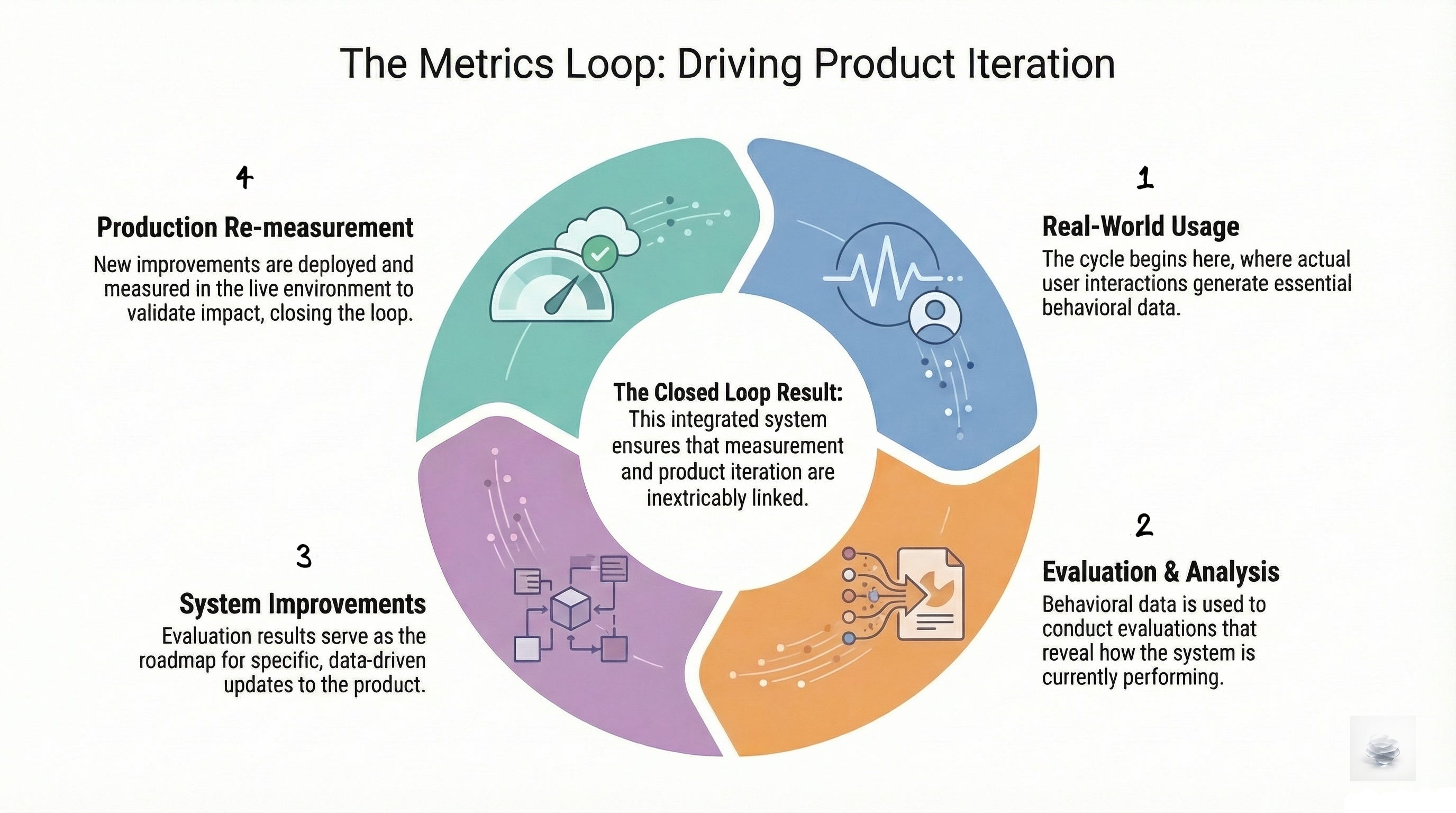
this creates a closed loop where measurement directly drives product iteration, as seen in ask lenny, a system built and documented in how i built ask lenny in a weekend, where feedback continuously reshapes output quality. without this loop, ai systems degrade in alignment with user needs over time.
connecting metrics to business outcomes
connecting metrics to business outcomes refers to mapping ai system performance and user interaction signals to measurable impact on revenue, retention, and productivity.
ai product metrics are only useful when they explain changes in business performance. output-level improvements must translate into workflow-level gains, which in turn influence economic outcomes.
this mapping operates across three layers:
revenue impact
revenue impact refers to how ai-assisted workflows increase monetization. this can include higher conversion rates due to faster content generation, increased throughput in paid workflows, or expansion of premium features enabled by ai capabilities. metrics such as acceptance rate and task completion rate often correlate with increased usage and willingness to pay.retention
retention refers to sustained user engagement over time. lower verification cost, reduced correction effort, and consistent task success improve user experience, leading to repeat usage. trust and reliability metrics are leading indicators of retention because they reflect whether users continue to depend on the system.productivity gains
productivity gains refer to reduction in time and effort required to complete tasks. this includes fewer iterations, lower cognitive latency, and higher assisted completion rates. productivity improvements can be measured at both individual and organizational levels, often translating into cost savings or increased output per user.
the relationship between metrics and business outcomes is not direct but causal through workflows. improvements in output quality matter only when they reduce user effort or increase success rates.
ai product metrics provide the instrumentation required to trace this path from system behavior to economic value. without this connection, optimization efforts remain disconnected from business impact.
related topics within ai product metrics
ai product metrics are closely connected to adjacent areas of ai product management.
ai product design for product managers: designing around probabilistic software
focuses on designing interfaces and workflows that account for probabilistic outputs and user interaction patterns.ai product reliability: a guide for product managers
focuses on consistency, failure modes, and system behavior under variability.how to evaluate ai products: a reliability framework for product managers
focuses on structured evaluation methods, including offline evals and benchmark design.ai evals are becoming the most important layer in ai products
focuses on building datasets, scoring systems, and comparison frameworks for model performance.workflow integration in ai products: designing ai systems for real user workflows
focuses on embedding ai systems into real user processes where value is created.
these topics together form a cohesive system for building, measuring, and improving ai products. ai product metrics act as the connective layer that translates system behavior into observable outcomes across all of them.