

ai product design refers to the discipline of building software products around probabilistic systems whose outputs cannot be guaranteed. unlike traditional software systems that execute explicit instructions and produce predictable results, ai systems generate outputs through statistical inference, even when the system functions correctly. these outputs may vary in structure, quality, or correctness even when the same input is provided. this behavior introduces a fundamental change in how software products must be designed and operated.
traditional product design assumes that the underlying system behaves deterministically. if the logic of the system is correct, the product interface can reliably expose system functionality without requiring users to question the validity of outputs. most software interfaces are therefore built around predictable state transitions, validated inputs, and reliable execution of commands.
ai systems break this assumption. large language models, computer vision systems, and other machine learning models produce predictions rather than deterministic results. because these predictions can occasionally be incomplete, inconsistent, or incorrect, reliability can no longer be guaranteed solely at the system layer.
ai product design exists to address this shift. it focuses on structuring workflows, interfaces, and verification mechanisms that allow users to work effectively with probabilistic system behavior. product managers must therefore design products that manage model outputs, expose uncertainty when necessary, and integrate human oversight into workflows where reliability cannot be fully automated.
this article examines how probabilistic software changes product design decisions. it explains how ai systems alter interface expectations, how uncertainty must be surfaced within product workflows, and how reliable ai products are built through thoughtful interaction design rather than deterministic system guarantees.
what ai product design means
ai product design is the discipline of structuring software products around probabilistic models whose outputs cannot be guaranteed. it focuses on designing workflows, interfaces, and verification mechanisms that allow users to operate effectively despite variation in model outputs.
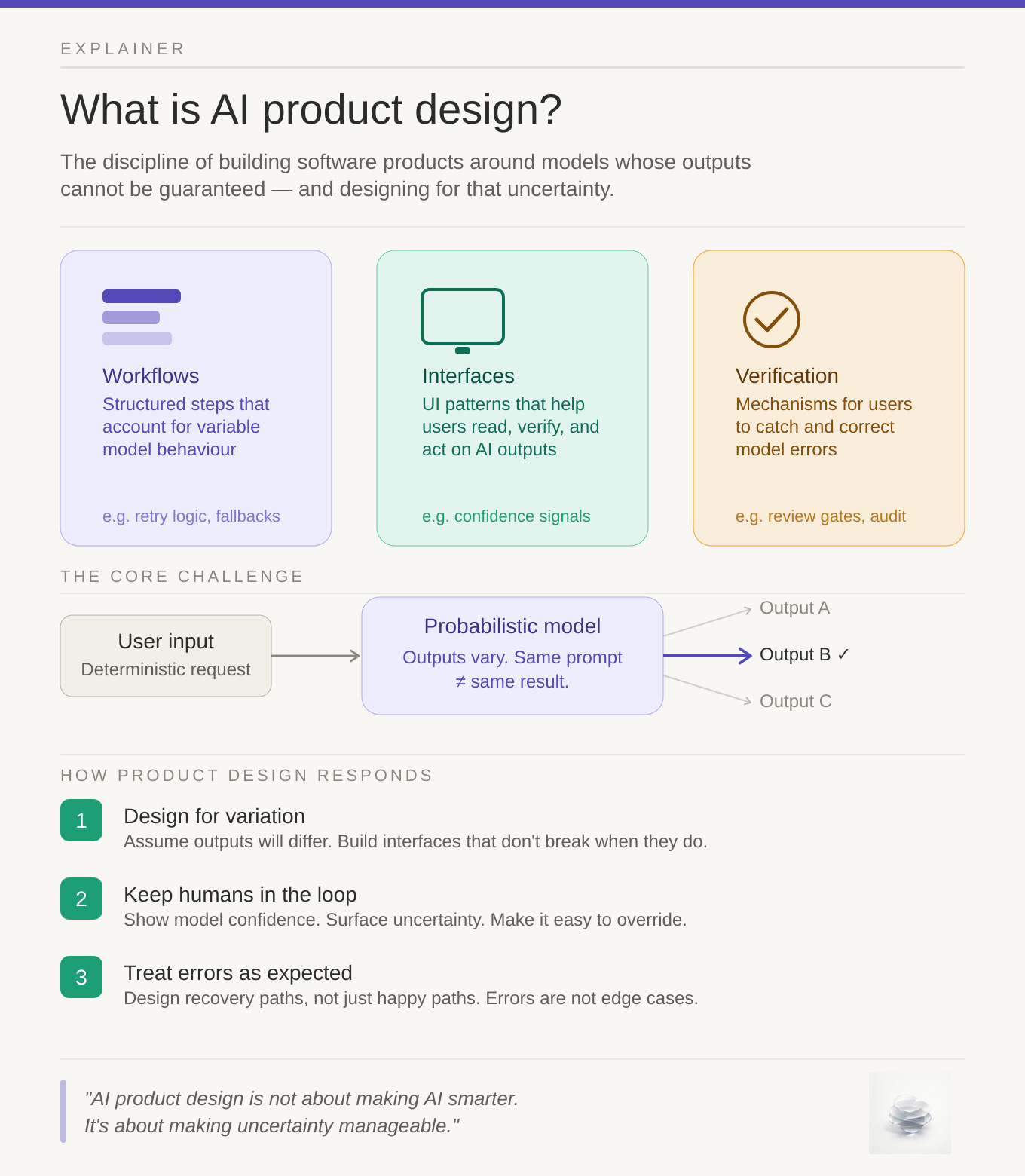
ai product design exists because ai systems behave differently from traditional software. deterministic software executes explicit instructions and produces predictable outputs for the same inputs. ai systems instead generate predictions based on statistical inference, a defining property of modern machine learning systems documented in the stanford ai index. the same input may produce different outputs, and some outputs may contain errors or incomplete reasoning. because model behavior cannot be guaranteed, the responsibility for reliability shifts partly from the model layer to the product layer. ai product design therefore focuses on structuring workflows, interfaces, and verification mechanisms that allow users to work effectively with probabilistic system behavior.
in traditional software systems, the correctness of the system is largely determined by the quality of the underlying logic and infrastructure. product design focuses on exposing system capabilities through interfaces that allow users to trigger actions, retrieve data, or configure system behavior. once a command is executed, the output is assumed to be correct if the system implementation is functioning properly.
ai products operate under a different constraint. machine learning models do not execute predefined rules. they generate outputs based on patterns learned from data. this means that correctness is not guaranteed even when the system functions as intended. as a result, ai product design must incorporate mechanisms that allow users to inspect, verify, and correct outputs when necessary.
product managers designing ai products must account for three structural properties of probabilistic software:
output variability
ai systems may produce different outputs for identical inputs. product workflows must therefore tolerate variation and allow users to regenerate or adjust outputs when needed.uncertain correctness
ai outputs may contain reasoning errors, hallucinated facts, or incomplete responses, a limitation widely discussed in research on large language models such as the gpt-4 technical report. the product must provide mechanisms that allow users to verify or inspect generated content before acting on it.context sensitivity
model behavior is strongly influenced by prompts, instructions, and surrounding context. product design must therefore carefully structure how user inputs are constructed and passed to the model.
these properties introduce new responsibilities at the product layer. instead of simply exposing system functionality, ai products must structure interactions that help users interpret model behavior and maintain trust in system outputs.
in practice, ai product design operates across three interacting layers:
model behavior
what the underlying model is capable of generating, such as text generation, classification, reasoning, or prediction.workflow design
how model outputs are integrated into the broader task the user is attempting to complete.interface design
how users view, inspect, modify, and verify generated outputs.
successful ai products emerge when these layers are aligned so that probabilistic model behavior is constrained by workflows that make errors observable and manageable.
deterministic vs probabilistic software interfaces
traditional software interfaces are designed around deterministic system behavior. when a user performs an action, the system executes predefined logic and returns a predictable output. identical inputs produce identical results, and the correctness of the system can be validated through testing and explicit rules. interface design in this environment focuses on exposing system capabilities clearly while minimizing friction in user interaction.
because deterministic systems behave predictably, users interact with them through commands that trigger reliable outcomes. the interface does not need to help users evaluate whether the output is correct. correctness is assumed if the system logic and infrastructure operate as intended.
deterministic interfaces
a deterministic interface is a product interface designed around a system that produces predictable outputs for identical inputs. the interface assumes correctness and focuses on enabling users to execute actions, retrieve information, and control system behavior through reliable commands.
examples of deterministic interfaces include:
database query interfaces
a query returns the same result whenever the underlying data has not changed.payment processing systems
transaction confirmation follows explicit validation rules and produces a reliable outcome.file operations
saving, deleting, or moving files produces deterministic state changes in the system.form submission workflows
user inputs are validated and stored according to predefined rules.
ai systems introduce a different type of system behavior. outputs are generated through statistical inference rather than explicit logic. the same input may produce multiple valid outputs, and some outputs may contain errors or incomplete reasoning. this variability changes how interfaces must be designed.
probabilistic interfaces
a probabilistic interface is a product interface designed around systems whose outputs are generated through statistical inference and may vary in quality, structure, or correctness. the interface must therefore help users interpret, verify, and adjust generated outputs rather than simply execute commands.
probabilistic interfaces incorporate interaction patterns that allow users to manage uncertain outputs. common patterns include:
output inspection surfaces
generated outputs are displayed in a way that allows users to review results before accepting them.editable results
outputs are presented as drafts or suggestions that users can modify rather than fixed system responses.regeneration controls
users can request alternative outputs when the initial result does not meet expectations.context visibility
the interface may expose prompts, instructions, sources, or reasoning steps that influenced the generated output.
these interface patterns reflect a fundamental difference between deterministic software and ai systems. deterministic systems execute commands, while ai systems generate predictions that must often be interpreted by the user.
the distinction between these two design paradigms becomes clearer when comparing the assumptions behind traditional software design and ai product design.
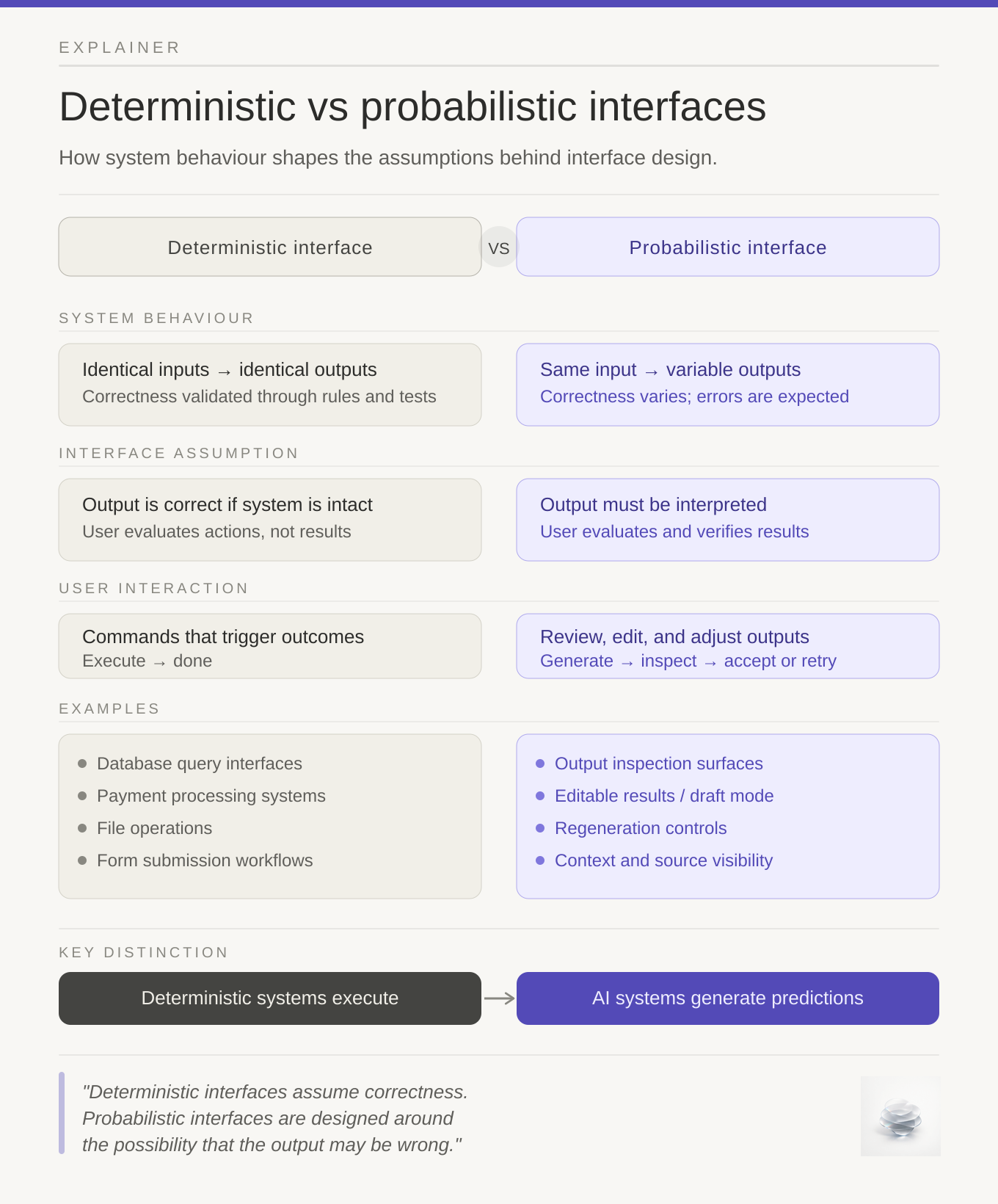
because ai systems introduce uncertainty into core product behavior, classical interface design assumptions begin to fail. users interacting with ai systems often treat outputs as suggestions rather than final answers. effective ai product design therefore structures interfaces that make generated outputs visible, editable, and verifiable rather than automatically executed.
designing ai products around uncertainty
ai systems introduce uncertainty into core product behavior because model outputs cannot always be guaranteed to be correct or complete. unlike deterministic systems, where outputs are either correct or invalid according to explicit rules, ai systems may generate outputs that appear plausible but contain subtle errors. product design must therefore structure interactions that allow users to understand and manage this uncertainty.
uncertainty in ai systems
uncertainty in ai systems refers to the inherent variability and potential inaccuracy of outputs generated through statistical inference. because ai models produce predictions rather than deterministic results, product interfaces must be designed to expose relevant context, reasoning, and supporting information that help users interpret system outputs.
designing around uncertainty does not attempt to eliminate model errors. instead, it focuses on structuring workflows that make model behavior visible and interpretable so that users can make informed decisions about whether to trust or verify outputs.
several design patterns help users work effectively with probabilistic systems:
progressive disclosure
progressive disclosure involves revealing additional information about a system output only when the user needs it. ai interfaces often present a concise response initially while allowing users to expand sections that show supporting context, reasoning steps, or references. this approach prevents interface overload while still providing deeper visibility when verification is required.
explanation surfaces
explanation surfaces are interface components that expose information about how an output was generated. these may include reasoning summaries, extracted evidence, or contextual inputs used by the model. explanation surfaces help users understand why the system produced a particular result.
citations and source attribution
for tasks involving factual information or document analysis, ai interfaces often provide citations or references to supporting sources. source attribution allows users to verify claims and inspect the original information used by the system to produce its output.
traceability
traceability refers to the ability to track how a model arrived at a specific output by inspecting intermediate steps or inputs within a workflow. traceability becomes particularly important in complex ai workflows where multiple reasoning steps or tools are involved.
step visibility
step visibility exposes intermediate reasoning or processing steps within a multi-stage workflow. instead of presenting only a final answer, the system may show how the task was decomposed and executed across several stages. this helps users detect errors earlier and understand the structure of the solution.
these design patterns improve the usability of probabilistic systems by making uncertainty observable rather than hidden. when users can inspect how a result was generated, they are better able to evaluate the reliability of the output and determine whether additional verification is required.
verification aware product design
ai systems frequently produce outputs that require user verification before they can be trusted or acted upon. unlike deterministic software, where system correctness is validated through testing and rule enforcement, ai outputs may contain plausible but incorrect information. product design must therefore account for the fact that users often verify ai results as part of their workflow.
verification in ai products
verification in ai products refers to the process by which users inspect, confirm, or validate ai-generated outputs before relying on them for decisions or actions. verification becomes necessary because probabilistic models can produce outputs that appear confident even when they contain factual or logical errors.
a key concept in ai product design is verification cost.
verification cost
verification cost is the time, cognitive effort, and workflow friction required for a user to confirm whether an ai-generated output is correct. high verification cost reduces the practical usefulness of ai systems because users must spend significant effort checking results before trusting them.
effective ai product design focuses on reducing verification cost while maintaining transparency around model behavior. several design patterns support this goal:
source visibility
showing sources or references alongside generated outputs allows users to quickly inspect the information used by the system. when sources are visible, users can confirm claims without performing separate searches.
structured outputs
structured outputs present model results in organized formats such as tables, lists, or labeled fields. structured responses reduce ambiguity and make it easier for users to evaluate whether the output satisfies the task.
step by step outputs
exposing intermediate reasoning steps allows users to verify the logic used by the system. step-by-step outputs are particularly useful for analytical tasks such as calculations, document analysis, or code generation.
editable drafts
ai outputs are often presented as drafts rather than final results. allowing users to edit generated content enables quick corrections without requiring the system to regenerate the entire response.
auditability
auditability refers to the ability to review how a system generated a result. audit trails may include prompts, retrieved documents, tool calls, or intermediate reasoning stages. auditability becomes critical in enterprise environments where decisions must be explainable and traceable.
verification-aware design improves user trust because the system acknowledges the need for inspection rather than hiding potential uncertainty. when verification mechanisms are integrated into the product workflow, users can evaluate ai outputs quickly and with minimal friction.
for many ai products, usability is determined not only by the quality of model outputs but by how efficiently users can verify those outputs within their existing workflows.
human-in-the-loop systems
many ai products operate as human supervised systems rather than fully autonomous systems, a design pattern widely documented in human-ai interaction research such as the google people + ai guidebook. while models can generate outputs, humans often remain responsible for reviewing, correcting, or approving those outputs before they are applied within real-world workflows. product design must therefore support structured collaboration between users and ai systems.
a human in the loop system is an ai-enabled workflow in which model outputs are reviewed, verified, or approved by a human before the result is finalized or executed. the human acts as a supervisory layer that ensures system outputs meet quality or safety requirements.
human supervision becomes necessary because probabilistic systems may produce outputs that are partially correct but require adjustment. instead of expecting perfect automation, ai product design structures workflows where humans and models contribute at different stages of the task.
ai systems typically evolve through stages of automation that gradually reduce the level of required human intervention.
stages of human oversight and delegation in ai systems
early-stage ai products often operate primarily in the draft or assist stages. the model generates suggestions, while the human remains responsible for evaluating the result. this approach reduces risk while still allowing users to benefit from model capabilities.
as reliability improves and workflows become better structured, some tasks can move toward the delegate stage, where ai systems complete actions with minimal supervision. fully autonomous automate stages are typically limited to narrow and well-defined tasks where error tolerance is low and outputs can be reliably validated.
for product managers, the design challenge lies in determining the appropriate level of human oversight for each task. workflows must make it clear when human review is required and when the system can safely act on its own.
human in the loop design therefore serves as a bridge between probabilistic model behavior and reliable product outcomes. by structuring workflows that incorporate human supervision, ai products can maintain reliability even when model outputs remain imperfect.
bounded ai workflows vs general ai assistants
ai systems can be deployed either as broad conversational assistants or as tools designed for narrow, well-defined tasks. in practice, ai products built around bounded tasks are often more reliable and easier to integrate into real-world workflows than general-purpose assistants.
bounded task systems
bounded task systems are ai products designed to operate within a constrained problem space where the expected inputs, outputs, and workflow structure are clearly defined. by limiting the scope of the task, the product can reduce variability in model behavior and make outputs easier to verify.
general assistants
in contrast to bounded task systems, general assistants attempt to support a wide range of open-ended queries and tasks. while this flexibility can be useful for exploration or brainstorming, it increases the surface area for errors because the model must operate across many domains with limited contextual constraints.
bounded tasks improve reliability for several reasons:
constrained context
when the task space is limited, the product can tightly control the context passed to the model. prompts, retrieved documents, and instructions can be structured in ways that guide the model toward predictable behavior.
predictable output formats
bounded tasks allow the product to require specific output structures such as summaries, classifications, extracted fields, or formatted reports. structured outputs reduce ambiguity and make verification easier.
smaller error surfaces
general assistants expose large areas of model behavior to the user. bounded workflows limit where errors can occur because the system only operates within a defined task.
clear evaluation criteria
when tasks are narrow, it becomes easier to measure whether the model performed correctly. this enables systematic evaluation, testing, and iterative improvement.
many successful ai products are designed around bounded tasks rather than open-ended assistants. examples include document summarization tools, code generation assistants, contract analysis systems, and customer support automation workflows.
for product managers, this distinction has important design implications. instead of exposing a general conversational interface, effective ai product design often narrows the scope of interaction so that the model operates within clearly defined task boundaries. constraining the task space reduces uncertainty, simplifies verification, and improves the reliability of the overall product experience.
designing reliable ai agent workflows
ai agents differ from single prompt systems because they execute tasks through multi-step workflows rather than producing a single response. instead of generating one output from a prompt, an agent may plan actions, call external tools, retrieve information, and combine intermediate results before producing a final outcome. this architecture changes how ai products must be designed.
ai agent workflows
ai agent workflows are structured systems in which an ai model performs a task through a sequence of coordinated steps that may include reasoning, tool usage, information retrieval, and intermediate decision making. the product is responsible for orchestrating these steps and presenting the resulting process to the user.
agent systems increase capability but also introduce new reliability challenges. each step in the workflow depends on the correctness of previous steps. if an early stage produces an incorrect result, the error can propagate through the entire workflow.
for example, an agent performing research may follow a sequence such as:
interpret the user request
retrieve relevant documents
extract key information from those documents
synthesize the results into a final answer
if the retrieval stage selects incorrect documents, the subsequent extraction and synthesis stages will operate on flawed inputs. the final answer may appear coherent even though the underlying reasoning chain contains errors.
because reliability compounds across steps, ai product design must make intermediate stages visible and controllable.
several design principles help manage agent workflows:
step visibility
interfaces should expose intermediate stages of the workflow so that users can understand how the system arrived at its result. showing retrieval results, intermediate reasoning, or tool outputs allows users to detect errors earlier in the process.
tool transparency
when agents interact with external systems such as databases, search engines, or application APIs, the interface should make these tool interactions visible. transparency helps users understand how information was gathered or actions were executed.
intermediate verification
products may allow users to review or approve intermediate outputs before the workflow continues. this reduces the risk that errors propagate through later stages.
structured orchestration
agent workflows should be organized into clearly defined stages rather than loosely connected prompts. structured orchestration improves reliability because each stage can be independently evaluated and monitored.
agent based systems demonstrate that ai product design is not limited to generating responses. the product must also design the orchestration layer that coordinates reasoning, tools, and intermediate outputs. reliability in these systems emerges from how the workflow is structured rather than from the behavior of a single model call.
reliability as a design outcome
reliability in ai products is often discussed in terms of model evaluation metrics such as accuracy, benchmark scores, or task completion rates. while these metrics provide useful signals about model capability, the reliability experienced by users is strongly influenced by product design. the structure of the workflow, the visibility of intermediate outputs, and the mechanisms for verification all determine how dependable an ai system feels in practice.
reliability in ai products
reliability in ai products refers to the degree to which users can consistently obtain usable and trustworthy outcomes from a system built on probabilistic models. because model outputs cannot be perfectly guaranteed, reliability emerges from the interaction between model behavior, product workflows, and user oversight.
product design influences reliability in several ways.
task boundaries
well defined tasks reduce uncertainty in model behavior. when a system operates within a constrained problem space, outputs become more predictable and easier to evaluate.
interface transparency
interfaces that expose context, reasoning steps, or source material allow users to understand how a result was generated. transparency makes it easier to identify errors and assess output quality.
verification surfaces
product interfaces can reduce verification cost by integrating mechanisms such as citations, structured outputs, and intermediate steps. these features allow users to inspect results without leaving the workflow.
human oversight
many ai products rely on human review for tasks where errors carry significant consequences. structured human oversight ensures that model outputs are inspected before actions are finalized.
these design elements demonstrate that reliability is not determined solely by model accuracy. even a high performing model can produce unreliable product experiences if workflows hide uncertainty or make verification difficult. conversely, thoughtful workflow design can allow users to work effectively with models that occasionally produce imperfect outputs.
for product managers, reliability therefore becomes a design outcome rather than a purely technical metric. the goal is not to eliminate model errors entirely but to structure interactions so that users can detect, interpret, and correct errors within the product workflow.
related topics within ai product design
ai product design sits within a broader set of disciplines that define how ai systems are evaluated, integrated into workflows, and operated within real-world software products. while this article focuses on how product managers design around probabilistic system behavior, several adjacent topics expand on the mechanics of building reliable and effective ai products.
ai product reliability: a guide for product managers
ai product reliability examines how product design, evaluation systems, and workflow structure influence whether users can consistently obtain trustworthy results from ai systems. reliability in ai products is not determined solely by model accuracy but by how product interfaces expose uncertainty, support verification, and structure human oversight.
how to evaluate ai products: a reliability framework for product managers
evaluating ai products focuses on measuring how well ai systems perform within real-world product workflows. this includes designing evaluation datasets, defining task specific metrics, and building evaluation pipelines that measure performance under realistic usage conditions.
ai evals are becoming the most important layer in ai products
ai evals describe structured methods used to measure the behavior of language model systems across representative usage scenarios. evaluation allows teams to quantify reliability, track failure patterns, and understand how the system performs under real-world conditions.
ai product metrics for product managers: measuring success in probabilistic systems
ai product metrics measure how users interact with ai features within a product environment. these metrics often include task completion rates, verification time, user correction frequency, and adoption of ai assisted workflows. product managers use these signals to understand whether ai features provide real productivity improvements.
workflow integration in ai products: designing ai systems for real user workflows
workflow integration examines how ai systems are embedded into existing user processes rather than functioning as isolated features. successful ai products typically integrate into tasks users already perform, augmenting decision making or automating specific steps within the workflow.
together, these topics form a broader body of knowledge that supports the design and operation of ai powered software products. understanding ai product design provides a foundation for exploring these related areas in greater depth.
these dynamics also influence broader product strategy, including how teams approach retention and growth in ai-native markets, explored further in product market fit in the ai era.