

over the past two years, ai products have proved that capability is not the bottleneck anymore; ai evals are how teams turn that capability into ai product reliability. ai systems can produce fluent language and impressive demos, but without a way to systematically evaluate ai outputs, reliability in real workflows stays unknown. as llm evals become a core part of ai product management, they determine whether assistants stay as curiosities or become dependable tools.
ai evals are structured methods used to measure the reliability of language model systems in real-world usage. unlike traditional software tests, they focus on how well ai outputs hold up across messy, probabilistic workflows instead of just checking fixed inputs and outputs.
in this guide you’ll learn what ai evals are, how to design evals for llm products, and how they impact adoption and retention.
introduction
over the last couple of years a predictable pattern has appeared across software products that introduced ai capabilities. the first public demonstrations created strong reactions because the systems produced fluent language, coherent summaries, and useful suggestions. early users interpreted this behavior as evidence that the feature was ready for everyday work. however, once these same features were used repeatedly inside real-world workflows, reliability problems surfaced. users began double checking responses, copying answers into search engines, or rewriting generated text before using it.
teams frequently explain this outcome by referring to model quality. the reasoning seems intuitive: if a system produces incorrect outputs, the model must not be good enough. this explanation does not match observed behavior. many companies are building on identical foundation models exposed through the same api providers, yet their products vary widely in consistency. the variable is therefore not raw intelligence but operational reliability.
this is the role of ai evals. evaluation in this context means structured, ongoing assessment of system behavior across realistic scenarios, instead of occasional manual inspection. it allows teams to quantify ai product reliability, track failure patterns, and understand how the system performs under real-world operating conditions. as companies continue shipping ai products, evaluation has shifted from a research activity to a core engineering and ai product management function. the rest of this article examines why traditional testing fails for language model systems and why learning how to evaluate ai outputs has become central to building dependable software.
if you’d rather listen, “ai evals for product managers” episode is live now.
why traditional software testing does not work for ai products
software engineering historically relies on a property called determinism. a deterministic system produces the same output whenever it receives the same input under the same conditions. if a payment service receives a request to charge a card for a specific amount, the system either completes the transaction or returns a defined error. correctness can therefore be verified through unit tests and integration tests. once a test passes, the behavior is considered stable because the program executes explicit instructions written by developers.
language model systems operate differently. a large language model does not execute explicit rules for each possible input. it predicts tokens based on probability distributions learned from training data. the same prompt1 can produce multiple valid outputs across different runs, temperatures, or contexts. correctness is no longer binary. it becomes statistical. a traditional program contains behavior encoded directly in its logic. a language model contains capability learned from data but behavior defined by context. prompts, retrieved documents, and surrounding software determine what the model actually does in a specific interaction. evaluation therefore measures system behavior rather than model intelligence. instead of asking whether the output is correct, teams must ask how often it is correct, under which conditions, and with what kinds of failures.
for a broader view of how system behavior, trust, and adoption fit together, see ai product reliability: a guide for product managers.
this distinction explains why traditional quality assurance processes break when applied to llm product design. unit tests verify fixed expectations. they assert that an output must equal a known value. an ai assistant summarizing a document or drafting a response has no single correct output. even when an answer appears coherent, it may contain fabricated details, outdated information, or subtle logical errors. a test cannot simply check for equality because multiple outputs may be acceptable and multiple unacceptable outputs may appear plausible.
github copilot provides a clear example of probabilistic reliability. developers frequently accept suggestions for boilerplate functions and repetitive patterns, yet they still review suggestions for database queries, authentication logic, and security sensitive code. the model is capable of producing correct implementations, but it occasionally generates insecure patterns or incorrect api usage. the result is not total failure but intermittent failure, which forces developers to verify outputs before execution. traditional testing assumes a program either works or does not work. a probabilistic system works often but not predictably, and this unpredictability is what makes reliability difficult to evaluate.
this behavior appears clearly in customer support automation tools such as intercom fin and zendesk ai. these systems handle routine questions effectively, including password resets and order status inquiries, but edge cases like refunds, billing exceptions, or account restrictions require precise policy grounding. when the assistant responds without correct retrieval context, it can generate plausible but incorrect instructions. companies therefore deploy escalation rules and human handoff thresholds because a single incorrect policy response can create financial cost and reduce operator trust in the system.
this leads to a shift in how to evaluate ai outputs. instead of writing tests that confirm a specific response, teams construct datasets representing realistic user scenarios and measure how often the system produces acceptable results. quality becomes a rate, not a state. ai product metrics therefore include accuracy percentages, hallucination2 frequency, and task completion success rather than pass or fail checks. this measurement approach resembles reliability engineering in distributed systems more than classical software verification.
ai product management must adapt accordingly. shipping ai products involves estimating confidence intervals around behavior rather than guaranteeing deterministic correctness. a model can perform well across most interactions while still creating unacceptable edge cases. without systematic measurement, teams observe only anecdotal success and mistake it for dependable behavior. the result is a product that performs convincingly in demonstrations but inconsistently in production.
the demo vs production gap
the reliability issues observed after launch are not random. they arise from a statistical mismatch between how ai features are evaluated before release and how they are actually used after deployment. demonstrations and internal testing typically rely on curated prompts chosen because they represent expected use. production usage, by contrast, contains messy, ambiguous, and poorly structured inputs that reflect real human behavior. this difference creates a sampling bias. the system appears dependable when tested against representative examples but encounters failure when exposed to the full distribution of real inputs.
a demonstration evaluates capability. a deployed product encounters variability. during a demo, a team may show a support assistant summarizing a clear ticket, a writing tool rewriting a clean paragraph, or a coding assistant generating a straightforward function. these cases are not fabricated, but they are selected. they occupy the center of the input distribution where language models perform best. production traffic rarely stays in that region. users paste partial emails, contradictory instructions, missing context, mixed languages, and domain specific terminology. the model is now operating at the edges of its learned patterns rather than the middle.
this difference explains why two companies using the same model can experience opposite outcomes while shipping ai products.
this effect became visible with ai search features such as google ai overviews and microsoft bing copilot. early versions occasionally produced confident but incorrect summaries, and users began cross checking answers through linked sources. even when most responses were accurate, the visible errors dominated perception. google later introduced clearer citations and retrieval grounding, not to improve fluency but to reduce verification behavior and restore trust.
reliability perception is asymmetric. one visible failure carries more weight than many correct responses because the user cannot easily identify when the system requires oversight. this creates a trust threshold. below a certain consistency level, users treat the system as a suggestion tool. above it, they treat it as an operational tool.
the demo environment rarely measures this threshold. internal evaluation often counts whether the model can produce a good response at least once. production reliability depends on whether it produces acceptable responses repeatedly. the difference resembles testing a bridge by driving a single car across it versus measuring its performance under continuous traffic and varying load conditions. capability is necessary, but consistency determines usability.
this is where ai product reliability becomes a measurable property rather than a subjective impression. teams must estimate error frequency across realistic usage patterns, and not just ideal prompts. ai product metrics therefore include rates such as task success under noisy inputs, factual accuracy across varied contexts, and stability across repeated interactions. these measurements reveal how often the user must intervene, which directly determines adoption.
if you want a concrete launch framework built on these measurements, how to evaluate ai product readiness walks through deciding when an ai feature is reliable enough to ship.
how ai product architecture affects reliability
a common misunderstanding in discussions about llm product design is the assumption that the model itself constitutes the product. in practice, the model is only one component in a multi stage system that transforms user input into an actionable output. reliability failures frequently originate not from the language model but from the surrounding architecture that prepares, constrains, and interprets its behavior.
a production system begins with user input, which is rarely structured. inputs often contain incomplete instructions, missing references, ambiguous phrasing, or domain specific terminology. before the model is invoked, the system must determine what information is relevant. this stage is typically implemented through retrieval3 mechanisms that search internal documents, databases, or prior conversations. retrieval quality directly affects output accuracy. if the system retrieves incorrect or irrelevant context, the model produces a coherent but incorrect response, not because reasoning failed, but because the information supplied to it was wrong.
the next stage is prompt construction. the system assembles instructions, retrieved context, formatting rules, and task constraints into a structured prompt. small differences in structure can significantly affect how the model interprets priorities. in many deployments, failures attributed to hallucination are actually prompt assembly errors, such as conflicting context blocks or missing constraints. this is a systems design problem rather than a limitation of the model.
after generation, many products include tool usage. the model may call external services such as databases, search indexes, transaction systems, or scheduling services. a support assistant might create a ticket, a finance assistant might categorize a transaction, or a coding assistant might modify a file. errors at this stage occur even when the generated language appears correct. a misinterpreted parameter or incorrect mapping between natural language and structured data can produce operational failures. this layer is central to ai agents product design because reliability depends on whether actions execute correctly, not merely whether text reads plausibly.
guardrails4 and post processing follow generation. systems apply validation checks, policy filters, and formatting enforcement to constrain probabilistic outputs into acceptable boundaries. they may validate outputs against schemas, check references, or block sensitive instructions. weaknesses here often appear as inconsistent behavior, such as an assistant occasionally violating policy rules or producing outputs that cannot be executed by downstream systems.
the final output is therefore the result of an entire pipeline rather than a single model decision. diagnosing reliability requires measuring each stage independently. a team that changes model providers without examining retrieval, prompting, and execution layers may see little improvement because the failure lies elsewhere in the system. evaluation becomes necessary because each component fails differently. retrieval errors produce confident misinformation, tool errors produce incorrect actions, and guardrail errors produce unsafe outputs. without measuring each layer separately, teams attribute all failures to the model and attempt upgrades that do not improve reliability.
observed deployments illustrate this architecture clearly. code assistants combine language models with repository context and static analysis. enterprise copilots connect to internal documents and permission layers. productivity assistants integrate with calendars and communication platforms. in each case, performance depends on how accurately the system gathers context, interprets instructions, and executes actions. fluent language alone does not guarantee dependable behavior if surrounding components mishandle information.
understanding this architecture changes how to evaluate ai outputs. performance cannot be treated as a single number attached to the model. teams must measure retrieval relevance, action accuracy, and guardrail effectiveness alongside generation quality. ai product metrics therefore span multiple layers of the system. ai product management shifts from selecting a model to orchestrating a dependable pipeline, because what users experience as an ai feature is coordinated behavior across several subsystems acting together.
the ai product reliability pipeline
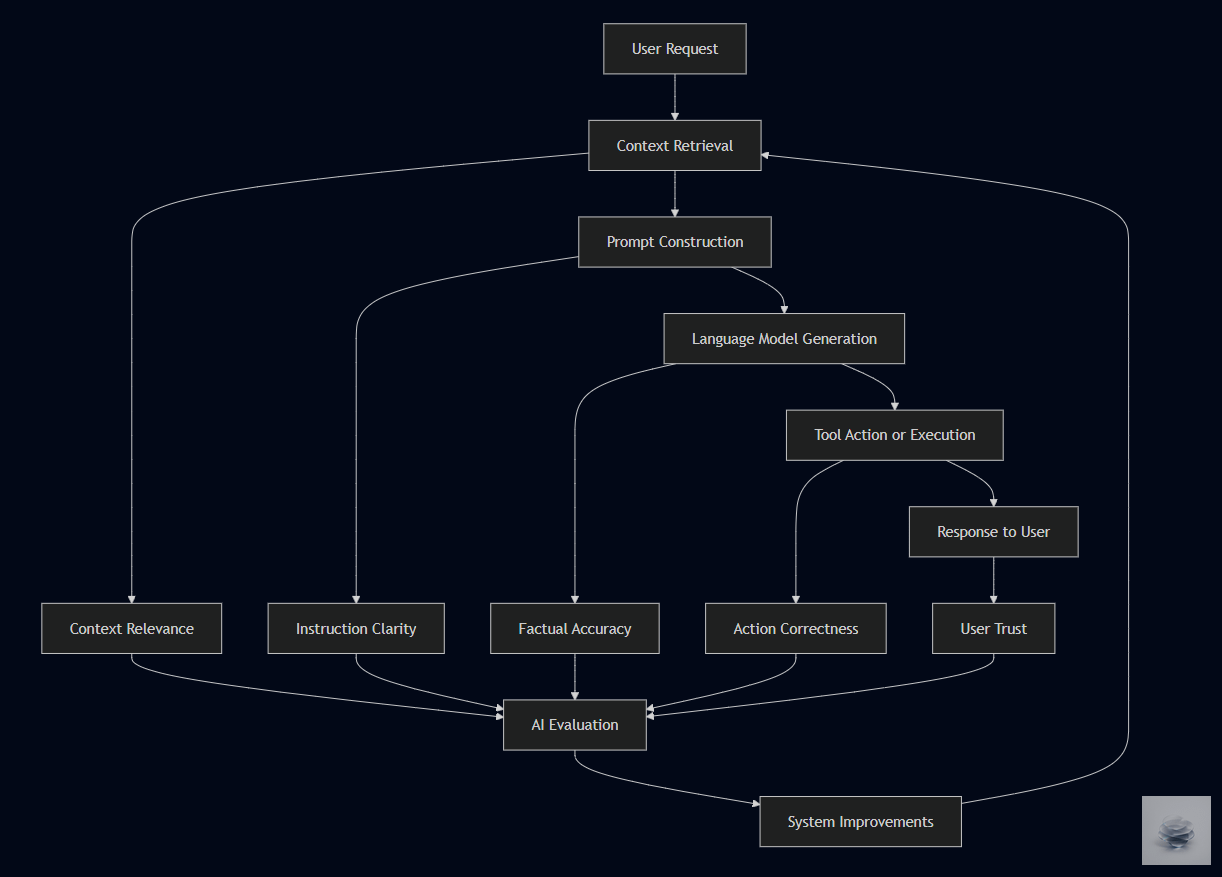
this diagram shows why reliability in ai products cannot be attributed to the language model alone. each stage introduces independent failure modes, and evaluation feeds corrections back into earlier stages. reliability therefore depends on system design and feedback loops rather than model capability alone.
why prompt engineering stops working at scale
teams building language model features usually begin by adjusting prompts. this works early because prompt structure strongly influences how the model interprets instructions and prioritizes context. clarifying tasks, adding examples, and specifying formats can significantly improve performance across observed cases, which creates the impression that reliability problems are primarily instruction problems.
however, this improvement slows quickly. prompt tuning optimizes behavior for inputs the team has already encountered, while deployed systems must handle inputs the team has never seen. the system is not evaluated against a single task but against a distribution of tasks, and optimizing instructions for a small sample cannot stabilize performance across the full range of usage.
language models generalize patterns rather than execute rules. when prompts include examples, the model learns a behavioral pattern from those examples. this works when future inputs resemble them, but performance degrades when inputs contain ambiguity, incomplete context, or domain specific language. an assistant that summarizes clean reports may perform well in testing but fail when given fragmented notes or conflicting instructions.
this leads to diminishing returns. each prompt change fixes a known failure but leaves unknown ones untouched. prompt engineering alters behavior but does not measure it.
the limitation is not that prompts are unnecessary. they define task boundaries and output format. the limitation is that prompts alone cannot characterize system reliability. dependable behavior requires measuring performance across many realistic scenarios rather than repeatedly rewriting instructions. this is the point where teams realize reliability cannot be achieved through prompt design alone and evaluation becomes necessary when shipping ai products.
what ai evals are and how they work
ai evals are structured measurement processes designed to estimate how a language model system behaves across a representative range of tasks. the goal is not to determine whether a single response is correct, but to quantify the frequency, type, and conditions of both acceptable and unacceptable outputs. unlike traditional testing, which verifies predefined outcomes, evaluation treats performance as a statistical property that must be observed repeatedly.
the need for this approach follows directly from the probabilistic nature of language models. because the same input can produce different outputs, quality cannot be inferred from individual interactions. a team manually checking a few responses is sampling behavior, not measuring it. evaluation replaces anecdotal inspection with controlled observation. the system is exposed to a dataset designed to approximate real usage, and the outputs are scored according to defined criteria. these criteria vary by product category. a coding assistant may measure compilation success and security patterns, a support assistant may measure factual correctness and policy adherence, and a document assistant may measure summarization accuracy and information retention.
evaluation typically occurs at multiple levels. offline evals run against static datasets before deployment. these datasets contain prompts or workflows representing common user tasks, edge cases, and known failure modes. the purpose is to detect regressions and compare system changes. if a prompt update, retrieval change, or model swap reduces accuracy across the dataset, the team detects the degradation before users encounter it. offline measurement therefore functions as a reliability baseline rather than a final guarantee.
production evals operate differently. once the system is deployed, behavior must be measured under live conditions because usage patterns evolve. real user inputs contain ambiguity and context combinations that cannot be fully simulated. production evaluation monitors outputs, samples interactions, and scores them through automated checks or human review. for example, an enterprise assistant may automatically verify whether referenced documents exist, while a human reviewer audits a subset of conversations to assess correctness. this continuous observation allows teams to understand how often failures occur and whether reliability improves over time.
human review loops remain necessary because some quality properties cannot be measured automatically. tone appropriateness, reasoning soundness, and contextual judgment often require human evaluation. organizations therefore incorporate feedback processes where reviewers rate outputs according to predefined guidelines. these ratings feed into ai product metrics that track trends such as hallucination rate, task success percentage, and policy compliance. the objective is not perfect accuracy but predictable behavior within acceptable bounds.
the distinction between evaluation and testing is important for ai product management. testing answers whether a feature functions. evaluation estimates how well it functions under variability. a support assistant that answers correctly in 85% of realistic cases may be usable if errors are detectable and recoverable. the same system becomes unusable if failures are unknown or misleading. evaluation therefore measures operational reliability rather than functional capability.
companies deploying large scale assistants illustrate this approach. code assistants measure how often generated code compiles and whether it introduces known vulnerability patterns. document assistants measure whether summaries preserve key information. conversational agents measure resolution rates and escalation frequency. these measurements inform decisions about shipping ai products because release readiness depends on quantified performance, and not isolated demonstrations.
learning how to evaluate ai outputs changes development workflow. improvements are no longer judged by whether a single example looks better but by whether metrics improve across many scenarios. evaluation converts reliability from an assumption into an observable property. for interface and workflow patterns that make this reliability visible and manageable to users, see ai product design for product managers.
once behavior can be measured, it can be improved systematically, which is why evals are increasingly treated as an engineering discipline rather than a research activity.
how evals drive ai product adoption and growth
evaluation is often treated as a quality assurance activity, but in ai systems it directly affects adoption. the primary barrier to sustained usage is not discovery or onboarding but confidence. users will experiment with an assistant once out of curiosity, yet they will incorporate it into daily workflows only if its behavior becomes predictable enough to reduce supervision. when users must constantly check outputs, the system saves time occasionally but consumes attention continuously, which discourages repeated use.
this relationship can be expressed through observable ai product metrics. frequency of usage, session duration, and task completion rates increase when outputs are dependable enough that users stop auditing each response. when reliability remains inconsistent, users treat the system as a suggestion generator rather than an operational tool. they may still open it, but they do not delegate meaningful tasks. retention declines because the cognitive effort required to supervise the system offsets the productivity benefit it promises.
evaluation affects this directly because it allows teams to identify which failure patterns prevent trust from forming. consider a writing assistant integrated into a professional workflow. if the assistant occasionally fabricates references, the user must verify citations every time. the productivity benefit disappears, and usage stabilizes at a low level. once evaluation identifies this failure mode and the system reduces citation errors below a tolerable threshold, user behavior changes. the user begins to rely on the assistant for drafting rather than only brainstorming. adoption expands without any change in marketing or interface.
evidence from deployed systems supports this pattern. code assistants increased daily usage in development environments after measurable reductions in compilation errors and insecure suggestions. the improvement was not a change in capability but in reliability frequency. developers began accepting suggestions automatically instead of inspecting each line. similar effects appeared in enterprise support assistants once incorrect policy responses were reduced. agents moved from double checking every answer to trusting routine responses, which shortened handling times and increased reliance on automation.
the mechanism is economic. ai product reliability reduces the user’s monitoring overhead. when verification effort falls below the effort required to perform the task manually, automation becomes rational. evaluation is the process that enables teams to reach this threshold because it reveals whether improvements actually reduce error frequency rather than merely changing examples.
ai product management consequently includes monitoring reliability trends alongside engagement metrics. instead of focusing exclusively on acquisition or activation, teams track error rates, correction frequency, and escalation patterns. when these metrics improve, retention often follows. evaluation is therefore not only a mechanism for preventing failures but also a mechanism for enabling sustained product usage, because dependable behavior is what converts experimentation into routine reliance.
case study: developer adoption of code assistants
early versions of coding assistants impressed developers in demonstrations but were used cautiously in daily work. engineers inspected almost every generated line because incorrect suggestions could introduce security vulnerabilities or compilation failures.
adoption changed as measurable reliability improved. once suggestion accuracy increased and insecure patterns decreased, developers began accepting completions automatically for routine code. usage expanded not because the system became more impressive but because it became predictable. the reduction in verification effort, rather than novelty, led to daily dependence.
this pattern illustrates a general rule: ai features are adopted when reliability crosses a trust threshold, and evaluation is the mechanism that allows teams to reach it.
how product ecosystems make ai evals more effective
evaluation effectiveness depends on exposure to diverse usage, and this is where product ecosystems influence reliability. a language model system improves when its behavior is observed across many real-world tasks, and not just synthetic tests. companies that operate broad software platforms receive continuous feedback from varied workflows, which allows them to detect failures earlier and refine systems more rapidly. the advantage is not only computational resources but also the breadth of operational signals available for measurement.
large platforms generate interaction data at scale. companies such as google and microsoft receive evaluation signals across large software ecosystems. gmail, google docs, and android interactions provide google with continuous writing and task data, while microsoft observes behavior through windows, microsoft 365, and github. these systems capture correction patterns, rejected suggestions, and abandoned actions at scale. the advantage is not only model capability but measurement coverage, since broader usage produces faster reliability improvement.
this explains why ecosystem depth influences ai product reliability and why the same dynamics show up in ecosystem led product growth. a company operating email, documents, and collaboration tools observes how assistants behave across writing, planning, and information retrieval contexts simultaneously. failures are detected not only through manual reporting but through measurable indicators such as correction frequency, user overrides, and task abandonment.
consider integrated productivity assistants embedded across workplace software. when an assistant drafts an email and the user repeatedly rewrites sections, the system records a correction pattern. when generated summaries are expanded manually, the system infers missing information. when calendar scheduling suggestions are rejected, the system observes incorrect constraint interpretation. each of these interactions becomes an implicit evaluation event. the system does not rely solely on explicit ratings; it learns from how users modify outputs. this provides a continuous method for how to evaluate ai outputs using behavioral feedback rather than only curated prompts.
the scale of these signals matters. a standalone application may receive thousands of interactions per day, while a platform spanning multiple services receives millions across varied contexts. larger datasets allow finer segmentation of error types and faster identification of regressions. when a change reduces accuracy in one workflow, the effect becomes visible quickly. improvements can therefore be deployed with confidence because evaluation coverage is broad.
ecosystem integration also supports ai agents product design. agents that interact with calendars, documents, and communication channels perform multi step tasks rather than isolated completions. evaluation must therefore measure whether the sequence of actions achieves the intended outcome. for example, a scheduling assistant is not judged only by language clarity but by whether meetings are scheduled correctly without conflict. platforms with integrated services can measure these outcomes directly, because they observe both the instruction and the resulting action.
evaluation therefore becomes a strategic capability. software platforms that collect diverse operational signals refine behavior more quickly because they can identify which errors occur most frequently and which corrections matter most. reliability improvement accelerates, which increases user dependence, which generates more feedback. ecosystems supply the observations that make evals effective, and evals convert those observations into dependable behavior.
the changing role of product managers
the shift toward evaluation based development changes the operational responsibilities of product teams. in traditional software, product management focused on defining functionality, prioritizing features, and coordinating delivery timelines. once a feature met its specifications and passed testing, its behavior was considered stable. ongoing work centered on expanding capability rather than continuously supervising performance. language model systems do not allow this separation between release and operation because behavior evolves with inputs and context.
ai product management therefore includes specifying acceptable behavior ranges, and not just functional requirements. a team deploying an assistant must decide what error types are tolerable, how often they may occur, and which failures require intervention. these decisions resemble reliability targets in distributed systems more than feature acceptance criteria. for example, a drafting assistant may tolerate stylistic variation but cannot tolerate fabricated citations. a support assistant may allow incomplete phrasing but cannot provide incorrect policy guidance. defining these boundaries becomes part of product definition.
measurement is necessary to enforce these boundaries. product managers must monitor ai product metrics such as correction frequency, escalation rate, and task completion success across usage scenarios. these metrics reveal whether users rely on the system or supervise it. if users consistently edit generated responses or bypass automated actions, the product is technically functioning but operationally failing. understanding this distinction requires continuous observation rather than periodic user feedback surveys.
this monitoring role also affects prioritization. improvements are selected based on failure patterns rather than feature requests. if evaluation shows that incorrect retrieval causes most errors, the priority becomes improving context selection rather than expanding capability. if failures occur during multi step actions, attention shifts to workflow orchestration and ai agents product design. development planning becomes data driven because reliability issues can be measured quantitatively.
shipping ai products therefore resembles operating a service rather than delivering a static tool. each system change, whether a prompt modification, model update, or retrieval adjustment, may alter behavior across many scenarios. evaluation datasets act as safeguards that detect regressions before deployment. product managers interpret these measurements and decide whether the system meets reliability thresholds for release. the decision depends not on whether the feature works in isolated tests but on whether measured performance remains within defined limits.
this responsibility also changes collaboration with engineering teams. instead of specifying interface behavior alone, product management defines behavioral expectations and acceptable uncertainty. engineers implement monitoring and evaluation pipelines, while product managers interpret outcomes in terms of user experience. reliability becomes a shared objective across design, engineering, and operations because unpredictable behavior affects trust directly.
the result is a shift in the discipline. feature design remains important, but the primary concern becomes dependable behavior across varied inputs. product managers are no longer only planning what the system should do; they are defining how consistently it must do it. evaluation provides the measurement needed to make that determination, making reliability oversight a core part of managing ai products rather than a peripheral quality activity.
faqs
what are ai evals?
ai evals are systematic methods for measuring how an ai system behaves across many representative tasks rather than judging isolated responses. a dataset of prompts, workflows, or user interactions is run through the system and the outputs are scored against defined criteria such as factual accuracy, policy compliance, or task completion. the objective is to estimate reliability, meaning how frequently acceptable behavior occurs and under what conditions failures appear. instead of asking whether one answer looks correct, evaluation quantifies performance across distributions of inputs.
are ai evals the same as testing?
they serve a different purpose. traditional testing verifies deterministic behavior by confirming that a program produces an expected output for a known input. language model systems produce variable outputs, so correctness cannot be validated once and assumed stable. evaluation estimates performance statistically. the system may pass some cases and fail others, and the measurement determines the rate and pattern of those outcomes. testing answers whether a function executes, while evaluation measures ai product reliability across varied scenarios.
can a better model replace evals?
larger or newer models can reduce certain errors, but they do not eliminate variability. a stronger model may produce more coherent responses while still generating incorrect information under ambiguous conditions or incomplete context. without measurement, teams cannot determine whether improvements reduce failure frequency or simply change its form. evaluation remains necessary because reliability depends on the interaction between model behavior, retrieval context, and system design rather than model capability alone.
why do ai apps hallucinate?
language models generate text by predicting likely token sequences based on patterns in training data. when a prompt requests specific information but the system lacks reliable context, the model may still produce a fluent response that appears factual. this is not intentional fabrication but probabilistic completion without verification. hallucinations often occur when retrieval fails, when prompts omit constraints, or when the system attempts to answer questions beyond its accessible data. measuring these events helps teams understand how to evaluate ai outputs and identify which parts of the pipeline require correction.
why do users abandon ai features?
users adopt automation only when it reduces effort. if an assistant occasionally produces incorrect or misleading results, users must review every output to avoid mistakes. the verification effort cancels the productivity benefit, so the feature becomes optional rather than integral. ai product metrics often show this pattern through low repeat usage and high correction frequency. once reliability improves and verification becomes unnecessary for routine tasks, adoption increases because the system can be trusted within normal workflows.
conclusion
the difficulty of building dependable ai software does not arise from insufficient intelligence but from insufficient measurement. language model systems behave probabilistically, and their usefulness depends on predictable behavior across varied inputs. without evaluation, teams rely on demonstrations and anecdotal testing, which emphasize successful examples and obscure failure patterns.
ai evals provide a method for observing behavior systematically. by measuring error frequency, task success, and correction patterns, organizations can determine whether an assistant can be relied upon without constant supervision. reliability improvements translate directly into adoption because users integrate automation only when they no longer need to verify every response.
companies that continuously evaluate and refine their systems gradually reduce uncertainty. as reliability increases, users delegate more complex tasks, engagement rises, and retention improves. organizations that focus only on capability create impressive demonstrations but struggle to sustain usage because trust never stabilizes.
for this reason, evaluation has become a central discipline in ai product management. it connects system behavior to user confidence and converts experimental features into dependable tools. the competitive difference between ai products is increasingly determined not by how intelligent the model appears but by how consistently the system behaves, and consistency can only be achieved when performance is measured continuously.


prompt
the structured instructions and context given to a language model to guide its output.
hallucination
a response where a language model produces confident but incorrect information because it predicts likely text rather than verifying facts.
retrieval
the process of fetching relevant documents or data and supplying them to a model as context before generation.
guardrails
rules, filters, and validation checks applied to ai outputs to prevent unsafe or incorrect behavior.